

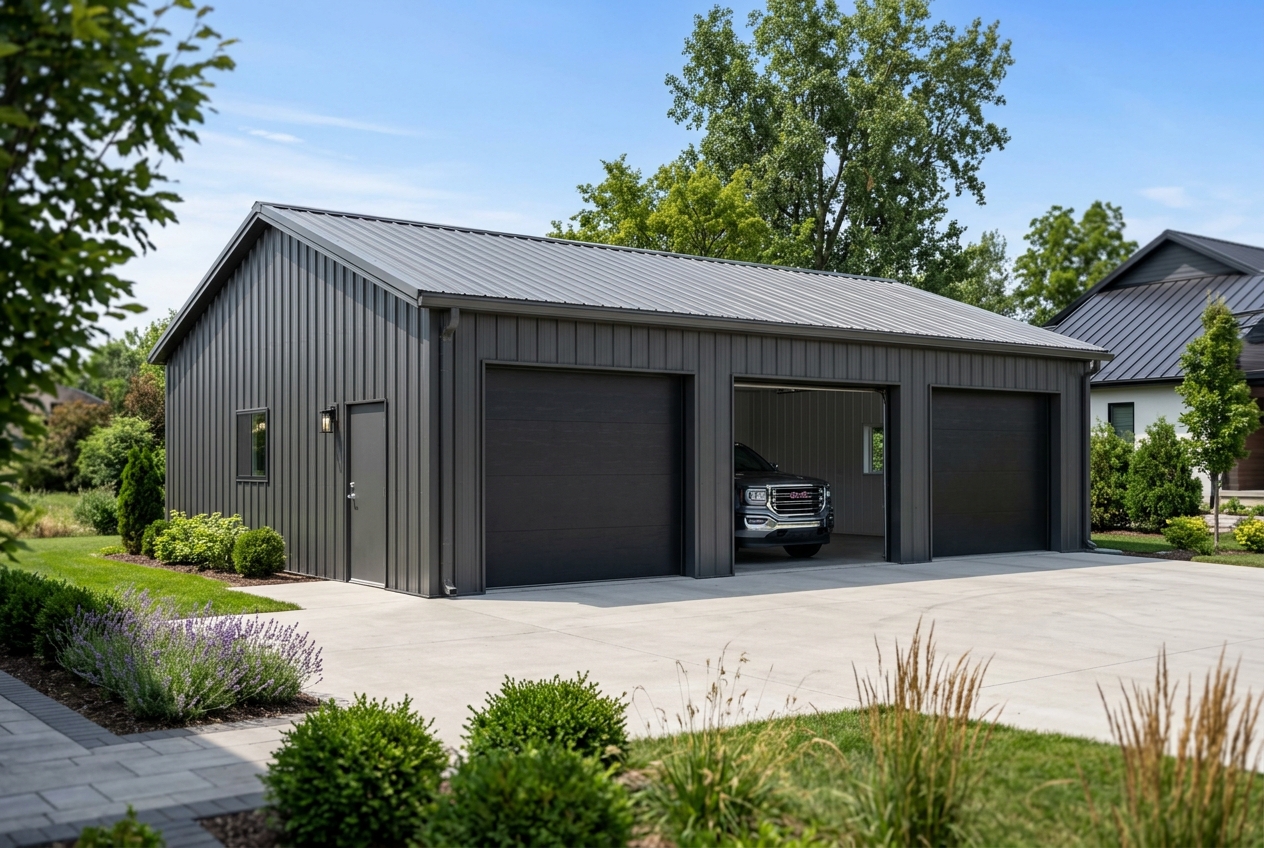
You’re probably frustrated if you’re using some old wooden shed that’s rotting away due to age or termites or whatever. The purpose of a garage is to keep your vehicles and/or tools and/or equipment safe and is not so that you have yet another thing to take care of! More homeowners and property owners are turning to steel as the preferred option for building a garage for this very reason. The strength, cost effectiveness, and flexible nature of steel make it an excellent garage building option compared to other typical materials like wood or concrete block. Whether you need to store a single vehicle, several trucks, or even a full-on workshop, you’ll find it difficult to pass up the benefits. Below is a list of the top five reasons steel “makes sense”, from real Performance data, to actual practical-use-criteria, etc.
Incredible strength and amazing ability to withstand weather conditions
Steel is one of the strongest types of construction material used by builders of both residential and commercial buildings. Thus, for new garages, steel provides both longevity and durability. Strong steel can build a garage to last at least 50 years, to often need major repairs in just 15 to 20 years, with very little maintenance required. This is because steel does not warp, bend, break, or split over time. Unlike other types of building materials, it will not lose its structural integrity when exposed to temperature changes or when exposed to moisture levels (and therefore not degrade from regular usage), either from the outside of the building or the inside.
Fire and pest protection at its best.
An often-overlooked advantage of steel is that it is noncombustible. From the standpoint of fire resistance, steel meets the highest fire rating available (Class A), which means that steel will not catch on fire or add fuel to any fire. Considering that most garages will contain gasoline, paint, solvents, power tools, etc., this is a pretty significant thing to think about. One small spark in a garage made of wood could have terrible results. That risk is greatly reduced with a structure made out of steel.
Pest resistance is another major benefit of steel buildings. Termites can cause up to $5 billion of property damage in the United States annually; garages are often targeted as they are typically constructed at or near ground level. Termites, carpenter ants, and rodents cannot chew through steel, nest in it, or damage it, which means you will never have to pay for fumigation or replace structural members that have been hollowed out by insects.
Extreme Wind and Snow Loads
You will need to ensure that your garage can withstand extreme weather conditions if you live in an area that regularly experiences hurricanes, tornadoes, or heavy snowfalls. Steel buildings are engineered with established wind and snow load ratings, which are dependent on local building codes. The majority of prefabricated steel garages manufactured today have wind ratings of 150 mph or greater and snow load ratings of 30 to 60 lbs per square foot, based upon the pitch of the roof, and the location.
Compare this to a traditional stick-built garage which relies heavily on the quality of each of its framing connections to provide resistance to wind uplift and horizontal lateral loads. Uniform material properties of steel allow for more accurate engineering calculations, so after construction, the building will more reliably perform as designed.
Cost-Effectiveness and Long-Term Value
The initial cost of building a steel garage is about the same or less than the price of an equivalent wooden framed structure to build. However, the real financial benefits come over the total life span of the garage. A steel garage will have a much lower rate of maintenance, lower insurance cost, short construction time that will result in less labor cost.
A basic garage design for one car made of steel would cost around $4,000-$10,000 for the necessary pure materials. A larger garage for two or three cars would tie in with the upper end of this number, approximately $10,000-$25,000 for the materials alone, prior to the addition of the cost for a foundation and other finishing items. The prices above are subject to regional and supplier differences, but are fairly comparable to those for wood framing. Better yet, the cost of owning a garage constructed of steel is considerably less than a comparable wood structure throughout the 30 years of ownership.
Reduced Maintenance and Insurance Expense.
Insurers prioritise managing risks. They appreciate the reduced risk steel buildings offer. For wood structures, steel structures typically receive a premium discount of 5% to 15%, especially in a wildfire and/or high-wind area. Over thirty (30) years, these saving total thousands of dollars.
Maintenance expenses are another evidence that steel structures possess cost saving benefits. On average, wood garages require significant amounts of time and money because of the need to paint or stain approximately every five to seven years (depending on location), standing seam roof replacement, along with checking for pest damage and rot. Steel garages require only an occasional wash and touch up if there happen to be any scratches on the panels. Maintenance costs for a steel garage is typically a small amount per year compared to what it takes to maintain a wood garage.
Fast Construction Timelines to Save on Labor
Steel garages are typically delivered as prefabricated kits (with pre-punched holes and pre-cut members and detailed instructions). Skilled crews can assemble a standard (2) car steel garage in (2-5) days compared to (2-4) weeks for traditional wood framed garage structures. The difference in the labor hours (with prefabricated steel garages) equals lower construction costs.
Easy-to-assemble units also lower the likelihood of costly mistakes for real estate owners working as their general contractors. The parts fit together in a proper order, which eliminates most of the guesswork of traditional framing
Design Versatility and Customization Options.
The notion that steel garages still basically resemble industrial warehouses is about 20 years behind. Modern manufacturers will provide you with an enormous variety of sizes, different types of roofs and a large selection of color options and design elements to choose from so that you can build a garage that matches whatever style that you prefer.
The options available for the roof design include gable, hip, monitor, and single-slope types. The wall panels are available in many different colours, wainscoting options, brick or stone accents, and residential entry doors. This allows the owner to build a structure that looks just like a traditional wooden or brick garage, while maintaining the performance capabilities of steel.
Clear-Span Interiors for Maximum Storage Space
This is the point where steel has an advantage over wood framing due to the higher strength per unit weight of steel compared to that of wood framing, allowing steel members to be used for much longer spans without the need for intermediate columns or load-bearing walls. For instance, a clear span garage constructed with steel can be as wide as 40 ft., 60 ft., or 100 ft. without the inclusion of interior posts.
By having an open-plan floor, you’ll be able to park cars together, install a car lift system, create a full-sized woodshop, or arrange the space in whichever manner that suits you without worrying about columns. A 60′ clearspan cannot be achieved with wood without using engineer-designed trusses that will be an expensive undertaking, so you will understand the advantages of steel.
The Appearance that Compliments Your Land
A lot of times the way your house needs to look is controlled by the Homeowners Associations or local zoning boards. Steel garage manufacturers now provide finishing options that will surely get past the most demanding review boards. The finish options include textured wall panels (that look like stucco or wood grain), standing-seam roofing (available in architectural colors) and decorative trim packages; all of these allow the steel building to match existing houses and outbuildings.
Flexible finishes are available for the inside of your building. You have the option to fit your inside with insulation and launch the drywalls of your project to give a finished appearance. You may also decide not to cover up the exposed steel, which would provide an industrial workshop like appearance, or you may choose to fit a liner panel, which provides a bright, easy-to-maintain surface as you work. This building can be finished to any level you choose, including the available options above.
Green Building, Sustainable Building
The Environmental impact has become the main concern for builders and property owners. Steel is one of the highest recycled material in the world and it continues to be produced with much more efficient production lines in the last twenty years.
Recycled Steel
Steel is completely recyclable with no loss of its strength or quality. The steel that was used to construct your garage likely has 25% to 35% recycled content right from the first day, and when your garage is finally taken down after many years of use, all of that steel can be melted down again and made into something new. This contrasts with a demolished, wood-framed garage, which generally ends up in a landfill.
The American Iron and Steel Institute (AISI) reports that steel is the leading recycled product in North America with an 80% recycling rate. When you select steel for your garage you are contributing to a real (i.e., “circular economy”), not just a marketing claim.
Energy Efficiency Through Modern Insulation
It is common for people to think of metal buildings as “heat boxes” in summer and “freezers” in winter. That used to happen in old style pole barn buildings that have no insulation. Now you can build steel garages with insulation that has the same R-value as conventionally constructed buildings. There are many types of insulation that work great on steel framed buildings including spray foam, rigid foam boards, or fiberglass batting insulation.
Panels constructed with insulated steel (i.e., sandwich panels) consist of two steel skins sandwiching a rigid foam core. As a result, insulated steel panels provide R-16 up to R-32 insulating value in a single product. Installation of the panels is fast, and insulated steel panels prevent thermal bridging, which is very difficult to eliminate with wood stud construction (every one of the wood studs acts as a thermal bridge for heat transfer).
Ease of Expansion for Future Needs
A smart reason to choose a steel garage is due to how things may change in five or ten years after the garage has been built. You may need additional storage space for a new boat, a new vehicle for your family, or some additional room for a part-time business. Expanding on a steel structure is relatively simple.
Because steel framed buildings are constructed using a modular framing system, it is possible to increase the overall length of your garage by adding additional “bays” to one end of the building. A qualified contractor can dismantle the end wall of your building, add additional framing sections, and re-assemble the end wall in just a few days. The additional framing will match exactly the same specifications as the original building.
A wood or masonry garage would be a much larger undertaking with new footings, changing the header, and possibly needing an engineer to ensure the old and new garages will function as one structure. With the modularity of steel, the future expansion can become transformation from a dream to reality.
Making the building bigger would also save your money. You are not building entirely new building after tearing down the old building. The cost per square foot would be normally less than compared to all-new construction and would be less disruptive to your property.
Reasons to Consider Steel as a Viable Option
A garage represents a major purchase, and your choice of material directly impacts how that purchase holds up in the long run. Steel meets or exceeds every important performance measure: durability, cost effectiveness, basic flexibility in designing it how you want, plus being environmentally sustainable and adaptable. Fire resistance, pest resistance, lifetime maintenance expense, interior flexibility…steel blows wood away in every category.
For your new garage project, be sure to request price quotes from a minimum of two to three steel building suppliers as well as your traditional contractors. Compare the 20-year total cost of ownership of the buildings, as opposed to just the initial purchase price. Verify what type of warranty will be offered, as the typical steel building panel warranty is between 25-40 years. Speak to past steel building/garge users to find out about their real life experience. In all probability the experiences will validate the statistical data that steel is generally the smarter long-term choice to build a garage.