The starting point for industrial building construction is to choose the skeleton of the building. Your choice of structural system will determine many things about your building, whether you’re building a warehouse that is 5,000 square feet or a manufacturing facility that is 100,000 square feet. This includes cost, timeline, flexibility, as well as the overall life and function of your building for the next 10-20 years. For over a hundred years, steel has reigned supreme as the material of choice in industrial buildings, primarily due to its very high strength to weight ratio when compared to concrete. Modern prefabricated steel building systems have reduced the amount of time it takes to construct and complete a building project (construction timeframes have been reduced from years to just a few months). But just because you know you’ll be using steel, it doesn’t mean that you should just select any steel system for your building. So not only do you need to consider what is going to be your best option for a structural system (full framed, partially framed, open frame, etc.), you need to consider all other components of the system as well as the approach to designing the building to fit your operation. The intent of this document is to provide you with all of the information required to properly select a structural system for your building by breaking all of the components down individually (type of frame, structural components, fabrication and installation, and long-term maintenance).
Essential Benefits of Steel Structures Used in Industrial Buildings
Key Benefits for Warehouses and Factories
The most important things that steel frame provides to industrial buildings/facilities are the large open floor area, quick construction, and flexibility. A steel framed warehouse can have a clear span up to more than 60 meters without any column inside. This allows the forklifts, conveyor systems and racks to be placed/arranged without considering structural obstacles when they are being used.
The second most significant benefit is speed. Since fabricators create steel sections off-site for quick bolt-assembly at the construction site, building a 20,000 sq.ft. warehouse normally takes eight to twelve weeks from ground-breaking to completed construction. In comparison, cast-in-place concrete often requires twice as long due to extended curing periods and formwork. Expanding steel buildings is relatively easy; when the design includes a compatible framing system, the process of adding bays or extending the building line becomes easy.
The discussion of steel vs. concrete often lacks a definite conclusion, but for most applications of factories and warehouses, steel wins on practical grounds. steel weighs less and therefore requires less of a foundation requirement and less restrictions because of soil type. Whether or not a steel column will support an equal amount of weight as a concrete column is approximately 70% less, which results in lower excavation costs and smaller footings.
Concrete offers some advantages in specific situations; for example, environments with heavy vibration, buildings that require extreme levels of fire resistance, or buildings where the thermal mass of the concrete assists in regulating internal temperature. In most cases, structural steel is much more ideal for industrial facilities, especially ones that are focused on fast construction times and/or providing future flexibility.
Structural Steel Building Systems
Pre-engineered steel buildings (PEB)
Pre-engineered buildings are created with an entire system in mind, right from the time they’re manufactured through to when they’re assembled. The engineering, manufacturing and mounting of cladding and accessories are largely the responsibility of the PEB supplier. There is no need for multiple coordination points that you will find with traditional construction because all of the building components (i.e. main frames, roof sheeting, etc.) are designed and manufactured to work together as a single unit.
PEB system is well suited for most varieties of warehouses and similar industrial buildings with clear span distances ranging from approximately 15 to 90 meters. PEB buildings are generally less expensive because most of their design has been somewhat standardised; engineers are copying from past projects and using computer programs and software to optimise the size of components. For example, in a 100′ Clear Span warehouse type PEB the engineers would design tapered I-beams that would be very deep at the knee of the beam (where most of the bending moment occurs) but fairly shallow at mid span of the beam because they can reduce the amount of steel used as they reduce the price of the building while maintaining strength.
Portal Frame Structures for Open Spans
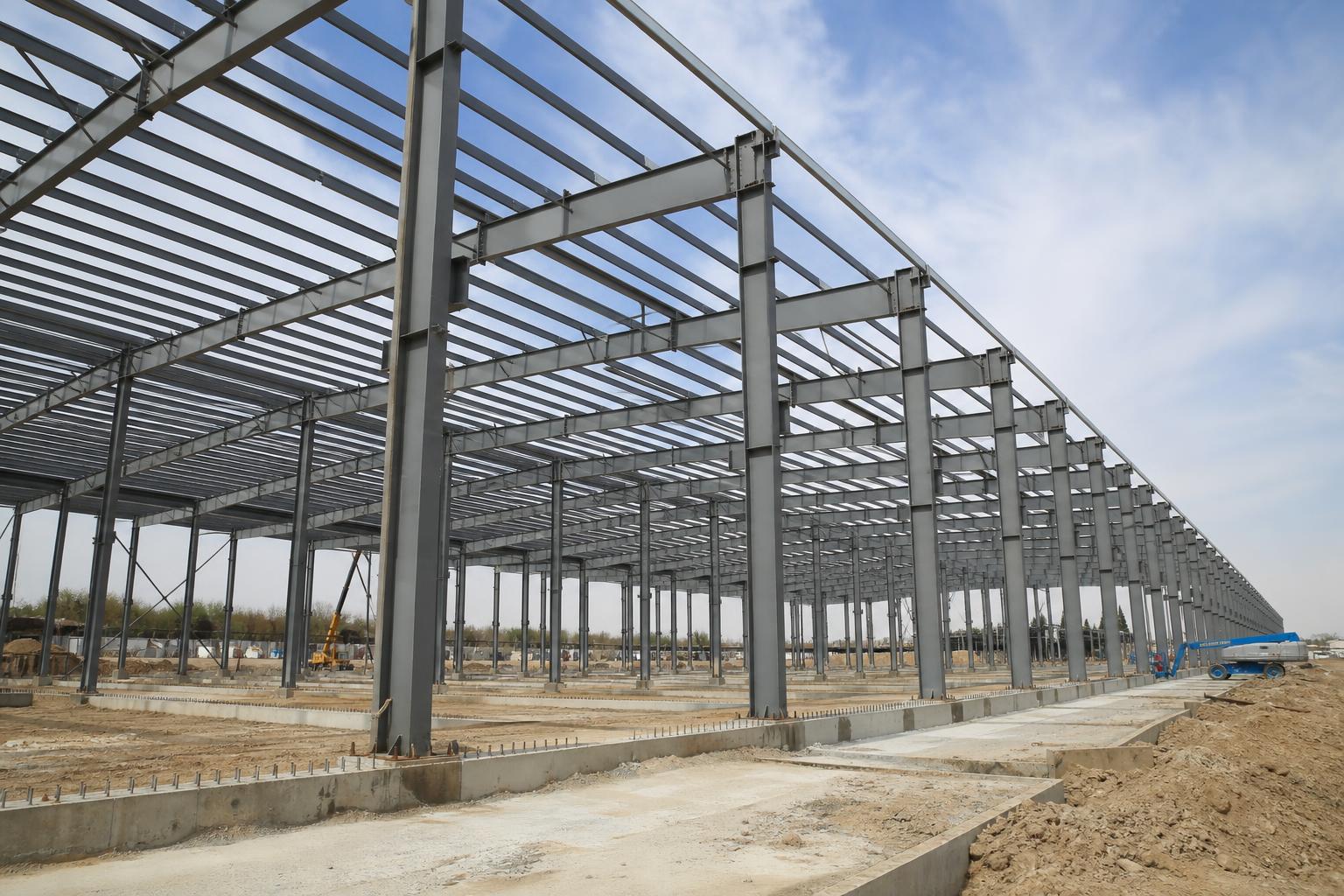
Portal frames serve as fundamental elements in steel construction for virtually all Industrial Buildings. The basic principle behind this building envelope consists in creation of rigid connections between columns and uniformly distributed rafters that provides a sturdy frame that holds vertical loads and lateral loads with no need for any interior bracing wall. Thus, it provides complete unobstructed interior space.
Portal frames work great for single span projects up to 50 metres. Multi span Portal Frames are a more economical option for longer buildings because of added support with columns between spans. The simple beauty of the Portal Frame System lies in its structural adaptability including Crane Rail Support, Mezzanine Support, etc. It can support a 10-tonne capacity Overhead Crane for the entire length of the Building without any major changes or modifications to the structure itself.
Lattice and truss systems for heavy load
Truss systems are typically the best structural choice when a span exceeds 50 meters or when the load on the roof is very high. A truss will distribute the loads between all its members (which are arranged in a triangular configuration) using geometry (arranged in large numbers of triangles), and therefore all members will be primarily carrying axial (tension or compression loads only, rather than bending loads).
Industrial building would usually utilize “Lattice Girder ” or “Warren Truss ” designs due to their capability to provide significant Clear-Span coverage and the added height of the wall or the Eave Height” being achievable due to their depth over the solid web design, and the construction of a building using this type of steel will generally provide the largest available Clear Span Buildings. However, with this great span and height, there will be more complicated fabrication processes as well as erection processes involved. It is difficult to find other steel framing systems that can outperform trusses when large areas that need to support critical loads demand extensive construction.
The Essential Parts of an Industrial Steel Framing System:
– Main Framing Members: Columns & Rafters
The Primary Frame is responsible for transferring all of the main loads to the foundation. Columns are usually hot-rolled H-sections or fabricated I-sections designed for the height of the structure and the loads applied to them as well as the presence of crane beams. Rafters connect column to column and establish the slope of the roof.
Most primary members of pre-engineered steel buildings are tapered and are typically fabricated from plates welded together on an I-shape profile that varies in depth throughout the member. The purpose of this methodology of fabricating these members is that it provides the maximum amount of material in the areas where it needs to bear the maximum amount of weight and removes as much of this material as possible where the weight is actually minimum. For example, a tapered rafter with a longer span of 30 meters can range from 450mm deep at midspan, yet the depth increases up to 900mm at the haunch Point.
The secondary framing consists of two things which are purlin and girts.
The roof sheeting is transferred to the main frame via the purlins attached horizontally to the rafters. For the walls, we have girts as equivalents to the purlins. The typical spacing is from 1.2 to 1.8 meters depending on the cladding system selected and wind load. Both are made of cold formed steel sections Z or C channel.
Bracing Systems to Ensure Lateral Stability.
While these members appear to be relatively minor parts of a building, their function is critical to the performance of the building as a whole. Appropriately designed purlins will minimize excessive deflection of the roof sheeting under snow and wind loads and will perform as a lateral restraint of the rafters to minimize buckling of their compression flange. One of the most frequent reasons for roof failure in lightweight steel buildings involves the incorrect spacing of purlins.
Each steel structure must be equipped with a lateral force resistance system for wind and seismic forces. Braces usually come as diagonally placed steel rods, angles, or cables that create an X shape or a V shape in a particular area of the building.
The horizontal wind loads on the roof are carried through the roof diaphragm and transmitted to the braced wall bays, which carry the loads downward to the foundations. If a steel frame appears structurally sound when subjected to gravity loads, it can collapse laterally without adequate bracing when acted upon by moderate wind. A competent engineer differs from an incompetent one by the quality of their bracing layout.
Design Principles to Maximize the Performance of Your Project
Calculation of Loads and Safety Standards.
All of a building’s structural pieces is sized in accordance with the specific sets of loads that are required by building codes. Each of the Dead Loads (i.e., the weight of the structure itself and the cladding); Live Loads (i.e., the weight of equipment, storage materials, and access for maintenance); Wind Loads, Snow Loads, & Seismic Loads is included in the design calculations.
The majority of countries using the limit states design standard generally adhere to both the ultimate limit state (ULS) as well as the serviceability limit state (SLS); the ultimate limit state provides an anti-collapse check while the serviceability limit state ensures control over deflection and vibration. To design steel in the United States according to standard is to use AISC 360 whereas in Europe the standard to use is Eurocode 3. Partial safety factors are included with these standards to help account for the various uncertainties which exist in the loading and material strength. False economy is the result when an engineer bypasses a thorough load analysis simply to save engineering fees. Alternate budgets on the backs of inadequate load assumptions will often create conditions of structural failures and/or expensive retrofits.
A clear span and eave height will contribute the greatest degree of overall facility performance. A warehouse that uses pallet racks to store products will most likely require a clear height between 10 to 12 meters under the lowest structural member. Warehouses that manufacture products and use overhead cranes to move products will probably require 15 meters or more of height.
An increase in spans and heights results in more structural steel, so the design approach needs to identify a location on the operational needs spectrum where they are satisfied without creating many more requirements for the structure than necessary. The use of tapered frames, optimal purlin arrangements, and bracing systems can reduce the total steel weight by 15-25 percent compared to a conventional frame design using uniform members.
Manufacturing and Installation Processes
Quality Control Measures at the Manufacturing Facility
Steel fabrication is done in factories under controlled conditions so that quality of work can be checked during all phases of production. CNC plasma or laser machines cut steel plates & members are assembled and welded into jigs to ensure accurate dimensions; ultrasonic or magnetic particle testing is used to inspect welded joints.
This controlled process provides tremendous advantages to prefabricated steel buildings. All bolt holes are properly aligned as they have been drilled through a machine, unlike the way the field worker uses a hand drill to do the same job, thereby, reducing the chances of having fitting problems onsite that would delay the schedule and increase the cost. Good fabricators have certifications like AISC or EN 1090. They must have documented quality management systems and they are regularly audited by third-party organizations.
Erection Techniques and Safety Procedures
Steel erecting is actually the most dangerous part of the entire process of building. The workers are constantly elevated; they handle very large objects and are around cranes in tight areas. If someone drops a beam or if a connection fails, there will be fatalities.
Erection sequences are developed beforehand, starting with the use of surveys on anchor bolts for the purpose of determining whether the foundation is correctly constructed; thereafter, the job proceeds from one end of the building to the next. Before raising rafters, the columns should be plumbed and temporarily braced. The two major safety measures for the erection crew are fall protection, isolation zones during the operation of a crane, and daily toolbox meeting. The most devastating accidents in the industry occur when crews are pushed to complete the building before the erection deadline.
Maintenance, Durability and Reliability of Steel structures
Rust-proofing and coating remedies
The biggest threat to steel is corrosion. in ~10 years a structural steel member in a high humidity industrial area can lose a lot of its cross section if not protected. In general, protection methods are based on the environment; for example:
In a mild environment, hot dipped galvanized steel will have at least 50 years of protection;
in moderately corrosive environments, polyurethanes over epoxy primers will do the trick;
in aggressive chemical or coastal environments, zinc-rich primers, and multi-coat systems are necessary;
and finally, weathering steel (Corten) develops a protective oxide layer but is not suitable for all environments.
Through regular inspections (usually every three to five years), it is possible to detect if the coating has started to deteriorate, allowing you to repair it before it becomes a structural issue. Early touchups are much less expensive compared to the cost of a complete recoating project.
Fireproofing and Thermal Insulation Strategies
Steel is at about half its strength at a temperature of 550°C; therefore, a bare steel frame will last approximately 15–30 minutes during a serious fire without fireproofing. Typical choices for fireproofing would include intumescent coatings (these will expand when exposed to heat, thereby forming an insulating, charcoal-like barrier) cementitious spray fireproofing, and also board fireproofing which can be attached to structural steel members and wrap around critical structural steel.
Thermal insulation also contributes to the efficiency of a building’s operation. When steel is not protected properly from heat and cold, it will produce wide fluctuations in temperature,condensation, and higher energy bills. The standard way to insulate a steel structure is to put either an insulated metal panel system, a fiberglass blanket between purlins and/or between girts, or both. Properly insulated steel storage can lessen the heating and cooling cost from 30 to 40% compared with unheated storage.
Choosing the Right Steel Structure for Your Project
The top-of-the-line industrial building made of steel is the one that is built to fit the way you intend to use it. It is not the least expensive to construct based on the initial price or something that appears to be great on someone else’s proposal. The first step in designing a steel building for your operations should be to consider some of the basic things you do, will do, or may do, and will eventually do in the future.
Be sure to obtain as many quotes from reputable prefab steel building manufacturers as possible. Make sure that the specifications are all the same, otherwise you won’t be able to compare pricing apples to apples. A building that’s quoted without any bracing detail will be significantly less expensive than one that includes bracing, or if the wall and roof will be significantly thinner than another quote. Also, be sure to work with an experienced structural engineer who not only understands the necessary code requirements but also understands how industrial facilities operate.
Most Industrial steel structures last for more than fifty years if they have been properly designed, fabricated and maintained. The cost of proper design and fabrication will pay off in the long term because the facility will require less
maintenance and provide flexibility in operations with the added benefit of peace of mind.
If you are considering a warehouse or factory construction project, it is important that you talk to engineers and fabricators early on in the process, as the decisions you will make within the first few weeks will be critical in determining how efficiently the building will operate for the next 25+ years.