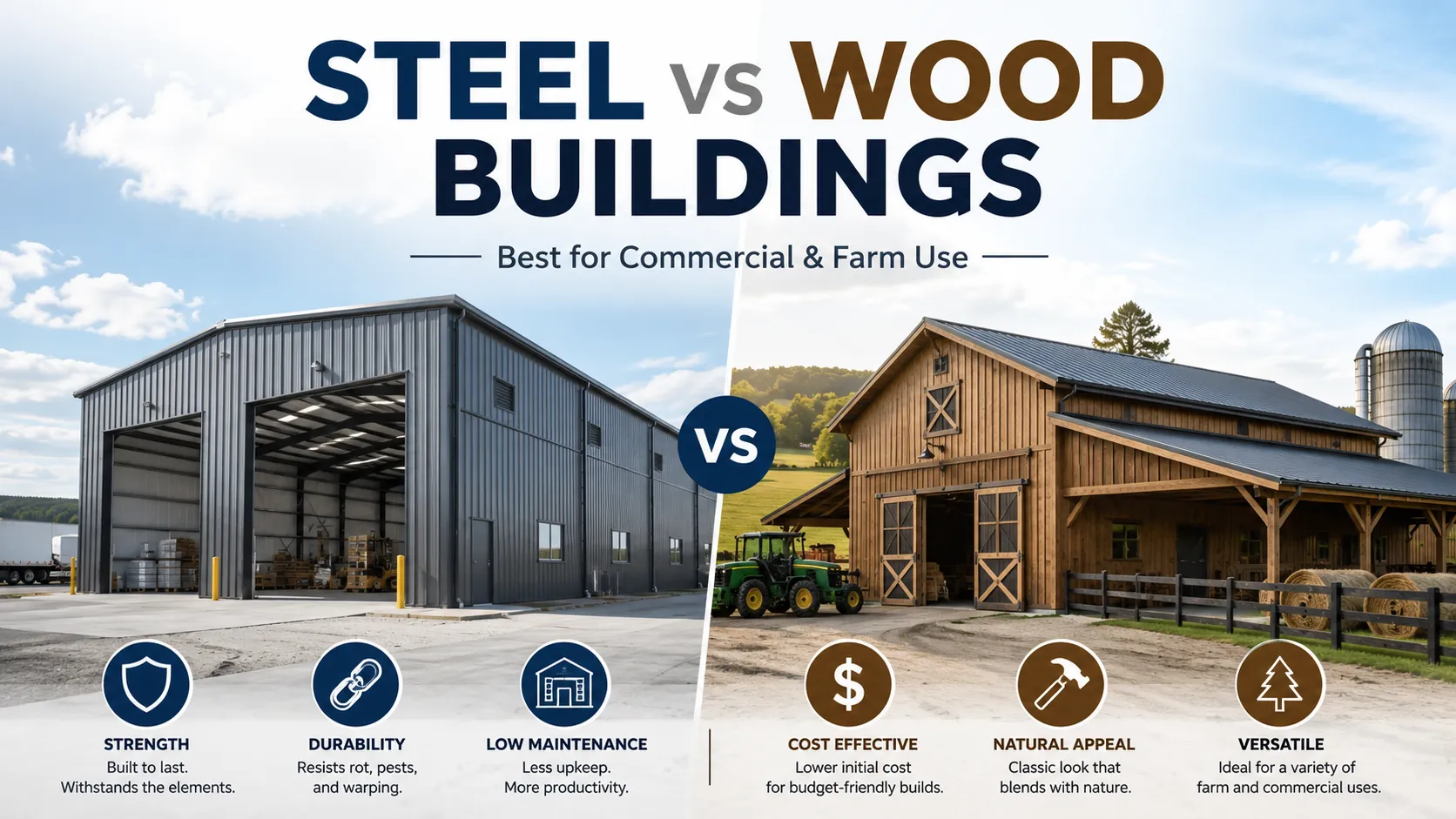
Choosing between steel and wood for a commercial or farm building is one of those decisions that ripples through your budget, your daily operations, and your sanity for decades. Get it right, and the structure practically pays for itself. Get it wrong, and you’re patching, repairing, or wishing you’d gone the other direction. The honest truth is that neither material wins every scenario. A 10,000-square-foot warehouse has completely different demands than a 3,000-square-foot cattle barn, and the best material depends on specifics: your climate, your use case, your timeline, and what you’re willing to spend upfront versus over 30 years. This guide breaks down steel versus wood buildings for commercial and farm use so you can make a decision based on real trade-offs, not marketing hype.
Core Differences Between Steel and Wood Framing
Steel and wood behave like entirely different animals once they’re part of a standing structure. Understanding those differences at a material level saves you from expensive surprises five or ten years down the road.
Structural Integrity and Lifespan
A well-maintained steel building can last 50 years or more with minimal structural degradation. Steel doesn’t warp, shrink, or split under load the way wood can over time. For commercial buildings that need to meet strict engineering codes, steel’s predictable strength-to-weight ratio makes it easier to design for heavy snow loads, seismic zones, and high wind areas.
Wood framing, particularly in post-frame construction, is no slouch either. Properly treated lumber in a well-designed structure can last 40-plus years. But wood is an organic material, and it responds to moisture, temperature swings, and load stress differently over time. You’ll see more settling and shifting in a wood-framed building, which can affect doors, windows, and attached systems.
Resistance to Pests, Rot, and Fire
Termites don’t eat steel. That single fact saves building owners in the southern and southeastern United States thousands of dollars in pest treatment and repair costs. Steel is also immune to fungal rot, which is a constant concern for wood structures in humid climates or buildings that house livestock and generate significant interior moisture.
Fire resistance is another clear advantage for steel. While no building is truly fireproof, steel framing won’t contribute fuel to a fire the way wood does. Insurance underwriters notice this, and it shows up in your premiums. Wood-framed buildings can be treated with fire retardants, but those treatments add cost and need reapplication over the building’s life.
Environmental Impact and Sustainability
Steel is one of the most recycled materials on earth. According to the American Iron and Steel Institute, roughly 93% of structural steel in the U.S. gets recycled. That’s a strong sustainability argument, especially as 2026 building codes increasingly reward recycled-content materials.
Wood has its own environmental story. It’s renewable, stores carbon, and requires less energy to manufacture per unit than steel. Locally sourced lumber for a farm building can have a smaller transportation footprint than steel shipped from a distant fabrication plant. Neither material is universally “greener” – it depends on sourcing, distance, and end-of-life plans.
Cost Analysis: Initial Investment vs. Long-Term Value
Price is usually the first question, but the real question is total cost of ownership. A cheaper building that needs constant maintenance isn’t actually cheaper.
Material and Labor Expenses
As of early 2026, steel building kits for a standard 40×60-foot structure typically run between $15,000 and $25,000 for materials alone, depending on gauge, insulation, and accessories. Wood framing for a comparable post-frame building might cost $12,000 to $20,000 in materials. Labor costs vary wildly by region, but steel erection crews often charge a premium because the work requires specialized equipment and training.
Wood framing labor tends to be more accessible. Most general contractors have crews experienced with wood construction, which means more competitive bids. For rural farm buildings, this availability gap can be significant: finding a steel erection crew willing to travel to a remote agricultural site sometimes adds 15-20% to labor costs.
Insurance Premiums and Maintenance Costs
Here’s where steel starts clawing back its higher upfront cost. Commercial steel buildings often qualify for lower insurance premiums, sometimes 20-30% less than comparable wood structures, because of their fire and pest resistance. Over a 30-year mortgage, that difference can total tens of thousands of dollars.
Maintenance tells a similar story. Steel buildings need occasional repainting or re-coating of exterior panels and fastener checks. Wood buildings need staining or painting, pest inspections, and periodic replacement of damaged boards or trim. A realistic annual maintenance budget for a wood farm building runs about 1.5-2% of the building’s value, while steel buildings typically fall closer to 0.5-1%.
Steel Buildings for Commercial Applications
Commercial projects often favor steel for reasons that go beyond durability. The design possibilities and functional advantages make steel a natural fit for businesses that need large, adaptable spaces.
Clear-Span Capabilities for Warehouses
One of steel’s biggest practical advantages is clear-span construction. A steel building can span 200 feet or more without interior support columns. For warehouses, distribution centers, and manufacturing facilities, that uninterrupted floor space is critical. Forklifts move freely, racking systems can be configured without working around posts, and the entire layout can be reconfigured as business needs change.
Try spanning 100 feet with wood framing and you’re looking at engineered trusses that are expensive, heavy, and still may require intermediate supports. For any commercial operation where interior flexibility matters, steel is the clear winner.
Design Versatility for Retail and Offices
Modern steel buildings don’t have to look like metal boxes. Insulated metal panels, stone veneer facades, and hybrid designs that combine steel framing with traditional exterior finishes give architects plenty to work with. Retail stores, medical offices, and mixed-use commercial buildings increasingly use steel framing behind conventional-looking exteriors.
The ability to easily integrate HVAC systems, electrical conduit, and plumbing into steel framing also simplifies commercial build-outs. Tenant improvements in a steel-framed retail space are generally faster and less disruptive than in wood-framed buildings, where cutting into load-bearing walls requires more engineering review.
Wood and Post-Frame Structures for Agricultural Use
Farm buildings have a different set of priorities than commercial properties, and wood construction has earned its dominance in agriculture for practical reasons that still hold true in 2026.
Thermal Properties for Livestock Housing
Wood is a natural insulator. A 2×6 wood wall has an R-value of about 5.5 before you add any insulation, while steel framing conducts heat readily and creates thermal bridging that can slash effective insulation values by 50% or more. For livestock housing, where maintaining stable interior temperatures directly affects animal health and productivity, wood’s thermal performance is a genuine advantage.
Condensation is another concern in animal housing. Steel buildings in cold climates can develop serious condensation problems on interior surfaces if not properly insulated and ventilated. Wood structures are more forgiving, absorbing and releasing small amounts of moisture without the dripping and corrosion issues that plague poorly designed steel barns.
Ease of On-Site Modifications
Farmers modify their buildings constantly. A new gate here, an additional feeder there, a partition wall for calving season. Wood buildings are incredibly easy to modify with basic tools. You can nail, screw, or bolt attachments directly to wood framing without special fasteners or welding equipment.
Steel buildings require self-tapping screws, specialized brackets, or welding for modifications. That’s not a deal-breaker, but it does mean that every small change requires more planning and potentially more expense. For a working farm where the building evolves with the operation, wood’s adaptability is a real, daily advantage.
Construction Timelines and Assembly Efficiency
How fast you can get from bare ground to a usable building matters, especially when you’re losing revenue or paying rent on temporary space while construction drags on.
Pre-Engineered Steel Kits
Pre-engineered steel building kits have transformed construction timelines. A typical 5,000-square-foot commercial steel building can go from foundation to weather-tight in three to four weeks with an experienced crew. Every component arrives cut, drilled, and labeled. The assembly process is closer to following a detailed instruction manual than traditional construction.
Lead times for ordering steel kits currently run six to ten weeks in 2026, depending on the manufacturer and customization level. Plan accordingly: if you need the building operational by a specific date, work backward from that deadline and add a buffer for foundation work and permitting.
Traditional Wood Framing Methods
Wood construction timelines are less predictable. A comparable post-frame building might take four to six weeks for framing and enclosure, but the process involves more on-site cutting, fitting, and adjustment. Weather delays hit wood construction harder since lumber shouldn’t be framed while wet, and exposed wood framing is more vulnerable to rain damage than partially assembled steel.
That said, wood construction has a lower barrier to entry for skilled labor. In rural areas where steel erection crews are scarce, a local crew experienced with post-frame construction can often start sooner and work more efficiently than an out-of-town steel team. The fastest building is sometimes the one you can actually get built with available labor.
Choosing the Right Material for Your Specific Project
The debate over steel versus wood for commercial and farm buildings doesn’t have a universal answer, and anyone who tells you otherwise is probably selling one of them. What matters is matching the material to the job.
If you’re building a commercial warehouse, retail space, or any structure where clear spans, fire resistance, and low long-term maintenance matter most, steel is almost certainly your best bet. The higher upfront cost pays for itself through lower insurance, less maintenance, and superior durability over decades.
If you’re building a livestock barn, equipment shed, or general-purpose agricultural building where thermal performance, easy modification, and accessible labor are priorities, wood post-frame construction remains an excellent choice. It’s proven, affordable, and perfectly suited to the realities of farm life.
For projects that fall somewhere in between, like a commercial agricultural processing facility or a large farm shop that doubles as office space, hybrid approaches work well. Steel framing with wood interior finishes, or a wood post-frame shell with steel roofing panels, can give you the best qualities of both materials. Talk to a structural engineer who has experience with both systems, get at least three bids, and make your decision based on your specific site, climate, and operational needs rather than on general advice from the internet. Your building will be standing long after the blog posts fade.