The construction industry has spent years talking about sustainability, but the conversation has shifted from aspiration to accountability. With global carbon budgets tightening and building codes catching up to climate science, the question of whether prefabricated steel buildings are genuinely eco-friendly in 2026 is no longer academic. It matters to developers calculating embodied carbon, to municipalities enforcing green building mandates, and to business owners who want a structure that performs well without leaving a heavy environmental footprint. Steel has always had a complicated relationship with sustainability: energy-intensive to produce, yet infinitely recyclable. The balance between those two realities has changed dramatically in the last few years, and the answer today looks different than it did even in 2023. Here’s where things actually stand.
The Evolution of Sustainable Steel Construction in 2026
The steel industry’s environmental profile has undergone a genuine transformation, driven by regulatory pressure, investor demands, and technological breakthroughs that were still in pilot stages just a few years ago. What was once one of the dirtiest industrial processes on the planet is being reworked from the ground up.
Advancements in Green Steel Production
Traditional steelmaking through blast furnaces accounts for roughly 7-8% of global CO2 emissions. That number has started dropping, and not just because of carbon offsets or creative accounting. Several major producers, including SSAB in Sweden and ArcelorMittal in Europe, now operate commercial-scale facilities using hydrogen-based direct reduction. This process replaces coking coal with green hydrogen, slashing emissions by up to 95% compared to conventional methods.
In 2026, green steel still carries a price premium of around 20-30%, but that gap is narrowing as production scales. For prefabricated building manufacturers who can lock in supply contracts, the cost difference is increasingly manageable, especially when factoring in carbon tax exposure and green building certification benefits.
The Shift Toward Net-Zero Manufacturing Processes
Beyond the steel itself, fabrication facilities have changed how they operate. Many prefab steel manufacturers now run on renewable energy, with solar arrays and battery storage powering cutting, welding, and coating operations. Factory-controlled environments also mean less wasted material: CNC plasma cutters and robotic welders achieve material utilization rates above 95%, compared to roughly 85% for traditional on-site construction.
Some facilities have achieved carbon-neutral certification for their entire production chain, from raw material intake to finished panel shipping. That’s not greenwashing. It reflects real investment in process efficiency, waste heat recovery, and renewable energy procurement.
Life Cycle Assessment: From Recycled Content to Infinite Reuse
A building’s environmental impact doesn’t stop at the factory gate. Life cycle assessment, or LCA, tracks everything from raw material extraction through decades of use and eventual demolition. Steel performs remarkably well across this full timeline.
High Recyclability Rates of Structural Steel
Steel is the most recycled material on Earth, and structural steel specifically has a recycling rate above 98% in North America. That’s not a theoretical number: it reflects actual demolition and scrap recovery data. When a steel building reaches the end of its useful life, the structural members retain nearly all their original properties after melting and reforming.
This is where steel differs fundamentally from concrete, which degrades during recycling and typically gets downcycled into road base. A steel I-beam from a warehouse demolished in 2026 can become a steel I-beam in a new building in 2027. The material loops back into service without losing quality, which is the textbook definition of circular material flow.
Reducing Construction Waste Through Modular Pre-Engineering
Prefabrication slashes construction waste by 50-70% compared to conventional building methods. Components arrive on site cut to specification, pre-drilled, and ready for assembly. There’s no pile of offcuts, no excess concrete, and minimal packaging waste.
A typical 10,000-square-foot prefab steel building generates less than two dumpsters of waste during erection. A comparable stick-built or cast-in-place structure might fill eight to ten. That difference matters not just for landfill diversion but for the embodied energy locked up in discarded materials.
Energy Efficiency and Thermal Performance Innovations
A building can be made from the greenest materials on the planet and still be an environmental disaster if it hemorrhages energy through its walls and roof. Steel buildings historically struggled here, since metal conducts heat readily. That weakness has been addressed with real engineering, not just marketing claims.
Next-Generation Insulated Metal Panels (IMPs)
Insulated metal panels have become the default wall and roof system for prefab steel buildings in 2026. Current-generation IMPs feature polyisocyanurate or mineral wool cores with R-values reaching R-40 or higher for wall assemblies. The panels interlock with continuous insulation and no thermal bridging, which eliminates the cold spots that plagued older metal building systems.
Some manufacturers now offer vacuum-insulated panel cores that achieve R-60 in just four inches of thickness. These cost more, but for cold-climate applications or buildings pursuing Passive House certification, they make steel structures competitive with the best-insulated wood or concrete alternatives.
Solar Integration and Cool Roof Technologies
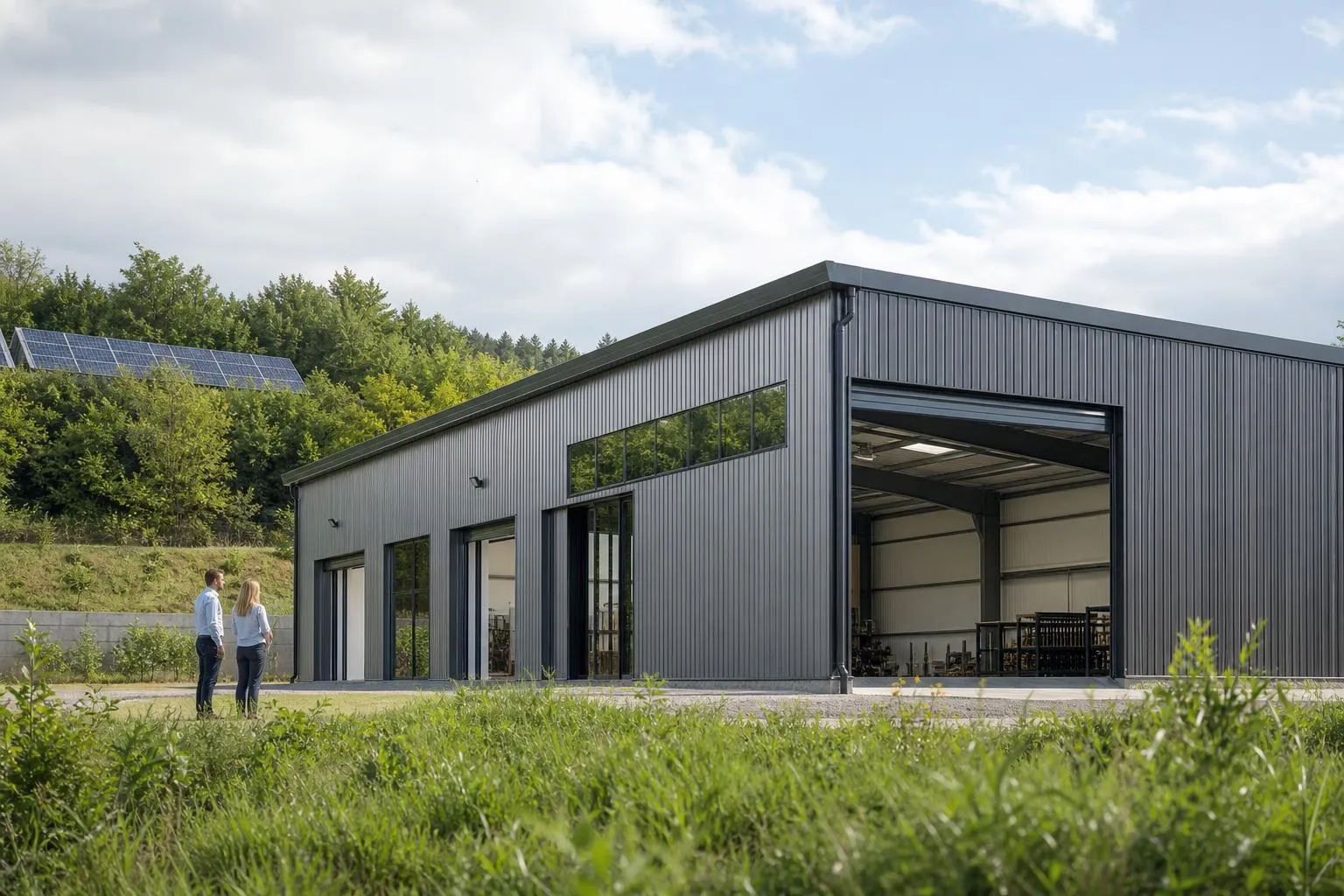
Standing-seam metal roofs are among the easiest surfaces to outfit with solar panels: the clamp-on mounting systems require no roof penetrations, preserving waterproofing integrity. In 2026, building-integrated photovoltaics (BIPV) have gone a step further, with solar cells embedded directly into metal roof panels. Several prefab manufacturers now offer these as a factory-installed option.
Cool roof coatings with solar reflectance indices above 80 are standard on light-colored metal roofs, reducing cooling loads by 15-25% in warm climates. Combined with solar generation, many prefab steel buildings now achieve net-zero energy performance within their first year of operation, depending on occupancy type and climate zone.
Reducing the Carbon Footprint of Logistics and Assembly
Even the most sustainably manufactured building creates emissions during transport and construction. Prefab steel’s advantages extend into these phases too, though the benefits depend heavily on geography and project planning.
Localized Fabrication and Optimized Transport Chains
Steel building components are dense and compact, which means fewer truckloads per square foot compared to lumber or precast concrete. A 5,000-square-foot steel building kit might ship on three to four flatbed trucks. The equivalent wood-framed structure could require six to eight loads of lumber, trusses, sheathing, and hardware.
Regional fabrication networks have expanded significantly. Most customers in the continental U.S. are now within 300 miles of a fabrication plant, which keeps transport emissions low and delivery times short. Some manufacturers have started using rail for longer hauls, cutting per-mile emissions by roughly 75% compared to trucking.
Minimizing On-Site Environmental Disruption
Prefab steel buildings go up fast: a typical commercial structure takes two to four weeks for erection, compared to three to six months for conventional construction. That compressed timeline means less heavy equipment idling on site, fewer worker commute trips, less soil disturbance, and reduced stormwater runoff from exposed ground.
Bolt-together assembly also means no wet trades. There’s no concrete curing, no adhesive off-gassing, and no paint overspray contaminating the surrounding area. For projects on sensitive sites near waterways or protected habitats, this low-impact construction method can be the deciding factor in permitting approval.
Durability as a Pillar of Long-Term Sustainability
The greenest building is the one you don’t have to replace. Steel structures routinely last 50-100 years with minimal maintenance, and many outlast that range. Unlike wood, steel doesn’t rot, warp, or attract termites. Unlike concrete, it doesn’t spall or develop structural cracks from freeze-thaw cycles when properly detailed.
Modern protective coatings, including fluoropolymer paint systems and hot-dip galvanizing, provide 40-plus years of corrosion resistance before recoating is needed. That longevity means the embodied carbon invested in manufacturing gets amortized over a much longer service life than most alternative building systems.
Prefab steel buildings also adapt well to changing needs. Adding bays, raising eave heights, or reconfiguring interior spaces is straightforward because the clear-span framing doesn’t rely on interior load-bearing walls. A building that can be modified instead of demolished represents enormous material and energy savings over its lifetime.
The Future Outlook: Steel’s Role in a Circular Economy
So, are prefabricated steel buildings eco-friendly in 2026? The honest answer is: more than they’ve ever been, and the trajectory is still improving. Green hydrogen steelmaking is scaling. Insulation and energy systems are closing the operational efficiency gap. Recyclability remains unmatched by any other structural material.
The remaining challenges are real but solvable. Green steel supply still can’t meet global demand, and the price premium limits adoption in cost-sensitive markets. Embodied carbon databases are improving but still inconsistent across regions, making apples-to-apples comparisons with timber or concrete difficult.
What’s clear is that steel’s role in a circular construction economy is growing. The material’s infinite recyclability, combined with prefabrication’s waste reduction and the rapid adoption of renewable energy in manufacturing, positions prefab steel as one of the strongest options for builders who take sustainability seriously, not just as a marketing label but as a measurable outcome.
If you’re planning a commercial, agricultural, or industrial building project this year, run the numbers on a prefab steel option. Compare the full life cycle impact, not just the upfront cost. The environmental case has never been stronger, and the economic case is catching up fast.