
Key Takeaways
- Steel structure buildings are tough and safe. They do not burn easily. They keep out bugs and stand up to storms.
- These buildings have open spaces inside. You can change or add rooms easily. This helps if you need more space later.
- Steel buildings save energy. They help lower heating and cooling bills. They also do not need much fixing or care.
- Builders use recycled steel for these buildings. This helps the planet and saves resources.
- Steel structures go up fast. This saves time and money when building them.
What are steel structure buildings?
Definition and Core Components
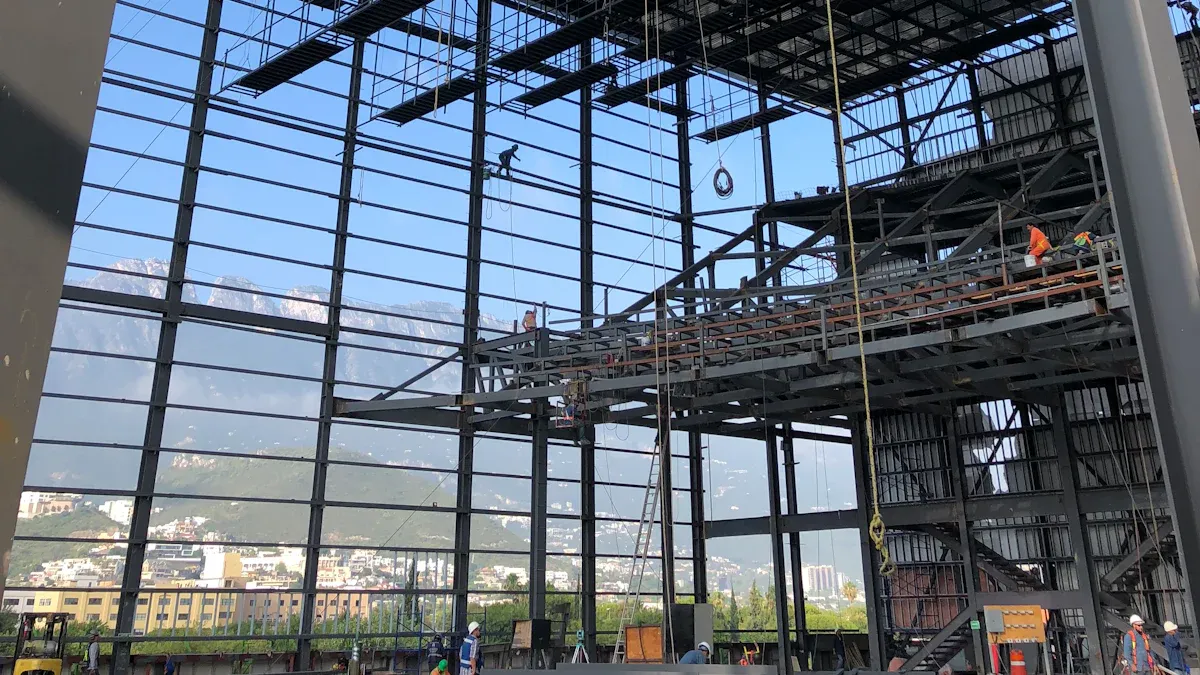
Steel structure buildings use steel for their main frame. In 2026, experts say these buildings have steel columns, beams, and braces. These parts work together to hold up the building. They help keep the building safe and strong.
Steel structure buildings are special because they are strong but not heavy. This lets people build tall or wide buildings. You do not need thick walls or lots of supports. These buildings are good for places like sports arenas or warehouses.
The main parts of steel structure buildings have different jobs. Each part is important:
| Component Type | Function |
|---|---|
| Primary Components | Columns and beams hold up the building and send weight to the ground. |
| Secondary Components | Purlins and girts connect the main parts and give extra support. |
| Eave Struts | These go where the wall meets the roof and help hold up the roof. |
| Bracing Systems | These help the building stand up to wind and snow. |
Other parts like rigid frames, trusses, and portal frames are also used. These help make different shapes and sizes for buildings. Structural steel is the backbone and holds heavy loads. Trusses use triangles to make roofs strong and light. Portal frames let you have big open spaces with few columns.
Comparison with Traditional Buildings
Steel structure buildings are different from concrete or wood buildings. Workers can put steel buildings together faster. The parts are made before they get to the building site. It is easier to change or add to a steel building than a concrete or wood one.
Here is a table that shows how steel, concrete, and timber compare:
| Material | Advantages | Disadvantages |
|---|---|---|
| Steel | Strong, flexible, easy to fix, quick to build, can be reused, can be made bigger, lasts long | Costs more, needs fireproofing, needs care, can bend under heavy loads |
| Reinforced Concrete | Very strong, does not burn, lasts long, needs little care, can be shaped, stiff | Takes time to dry, costs more to shape, needs thick parts, can shrink |
| Timber | Light, strong when pulled, quiet, found nearby, good for the planet | Can shrink or swell, can rot or get bugs |
Steel structure buildings are stronger and more flexible than wood or concrete. You can build taller and wider buildings with steel. Steel parts are made in factories, so you know what you will get.
Tip: If you want a building that goes up fast and can change later, steel structure buildings are a good choice.
Steel structure buildings use new engineering to meet today’s needs. They are strong, safe, and ready for the future.
Key Characteristics of Steel Structures
Strength and Durability
You want a building that stays strong for a long time. Steel structure buildings are very reliable. Structural steel is made for building things. It is stronger and tougher than regular steel. It has less carbon, so it bends more and is easier to weld. This helps your building hold heavy things and face bad weather.
Here is a table that shows the main mechanical properties of steel:
| Property | Description |
|---|---|
| Tensile Strength | The maximum stress a material can withstand before deforming, crucial for preventing fracture. |
| Yield Strength | The stress level at which a material begins to deform permanently, indicating safe load limits. |
| Ductility | The ability to deform without fracture, important for structures to withstand seismic activity. |
Steel structure buildings are light but very strong. They can handle big forces. Concrete and wood are not as good as steel here.
| Material | Strength-to-Weight Ratio | Key Advantages |
|---|---|---|
| Steel | Superior | Lightweight, durable, non-combustible |
| Wood | Lower | Susceptible to warping and pests |
| Concrete | Requires reinforcement | Heavy, needs substantial foundations |
Tip: Steel structure buildings are a smart pick if you want a safe and long-lasting building.
Insulation and Energy Efficiency
Steel structure buildings help you save energy and money. They are easy to insulate. You can use special roofs to keep heat out. Steel frames stop air from leaking in or out. This keeps the inside temperature steady.
Here is a table that compares steel structure buildings with traditional buildings:
| Aspect | Steel Structure Buildings | Traditional Buildings |
|---|---|---|
| Insulation | More effective insulation | Requires significant upgrades |
| Air Leaks | Not prone to air leaks | Prone to air leaks |
| Energy Savings | Can reduce electricity bills by 50% | Requires costly upgrades for energy efficiency |
| Temperature Consistency | Maintains consistent indoor temperatures | Needs additional insulation and weather-stripping |
You spend less on heating and cooling. You also do not need much maintenance, so your building lasts longer.
- Steel buildings are easy to insulate well.
- Reflective roofs help save more energy.
- Less maintenance means you save money over time.
Flexibility and Versatility
Steel structure buildings let you pick the layout you want. You can change the inside or make the building bigger later. Open floor plans give you lots of space. These buildings work for sports, storage, offices, or stores.
| Evidence Description | Feature Type |
|---|---|
| Steel buildings can be tailored to meet specific business needs, allowing for various layouts and aesthetic preferences. | Customizability |
| Their open interiors and customizable exteriors make them suitable for almost any business type. | Versatility |
| With their open floor plans and clear span designs, steel buildings provide flexibility in layout. | Flexibility in Layout |
| Steel buildings can be easily expanded or modified in the future, allowing for growth and adaptability. | Future Expansion |
| Steel buildings are known for their cost-effectiveness and energy efficiency. | Cost-effectiveness |
You can pick different styles for steel structure buildings. You can choose modern, traditional, or even custom looks. This helps steel buildings fit anywhere.
| Architectural Style | Description |
|---|---|
| Modern | Features sleek, minimalist designs with open layouts and customizable finishes. |
| Traditional | Can replicate wood or brick appearances, blending with historical designs. |
| Industrial | Exposed steel designs suitable for warehouses and factories, appealing for functional needs. |
| Urban | Designed to fit architectural norms of urban areas with aesthetic finishes. |
| Suburban | Often includes colored panels or textured exteriors for aesthetic appeal. |
| Rural | Durable, simple designs that complement natural surroundings. |
| Custom Branding | Customizable colors, signage, or logos to create a distinct look aligned with branding needs. |
Note: Steel structure buildings are a good choice if you want a space that can change and last.
Sustainability and Recyclability
Steel structure buildings are good for the planet. Most steel used in buildings comes from recycled steel. In North America, most structural steel is made from recycled stuff. When a building is done being used, almost all the steel gets recycled again. In the U.S., people recycle millions of tons of steel every year.
- Most new structural steel has 93% recycled steel.
- Almost all structural steel is recycled at the end of its life.
Steel can be recycled many times and stays strong. This means we do not need as many new materials. Making steel now uses less energy and saves more energy too. Steel buildings last a long time, so you use fewer materials.
| Benefit | Description |
|---|---|
| Recyclability | Steel can be recycled indefinitely without losing strength or durability, reducing the need for raw material extraction. |
| Energy Efficiency | Modern steel production is more energy-efficient, using less energy per ton produced and implementing energy recovery systems. |
| Longevity | Steel structures have a longer lifespan, leading to fewer materials consumed over time and lower environmental impacts. |
Callout: If you care about the earth, steel structure buildings are a great pick.
Steel structure buildings are strong, save energy, can change, and help the planet. When you ask, “What are steel structure buildings?”, you see they are ready for today and tomorrow.
Types and Uses in 2026
Main Types (Frame, Truss, Modular)
You can choose from several main types of steel structure buildings in 2026. Each type fits different needs and projects. Here is a table to help you see the differences:
| Type of Steel Structure | Description | Applications |
|---|---|---|
| Light-gauge steel framing | Works well for homes and small shops. Used for walls that do not hold up the whole building. | Houses, small offices |
| Structural steel framing | Best for big buildings. Gives strong support for tall or wide spaces. | Large offices, shopping centers |
| Pre-engineered steel framing | Built in a factory and put together fast on site. Saves time and money. | Factories, warehouses |
You can also find modular steel buildings. These buildings use parts made in a factory. You get faster construction and lower costs. Modular steel buildings go up quicker than wood or concrete. You also save money over time because steel does not rot or get termites. For example, a project in Washington D.C. saved $1.7 million by switching to steel. You can see that steel buildings help you finish projects faster and spend less.
Tip: If you want a building that goes up fast and lasts long, modular steel is a smart choice.
Common Applications
You see steel structure buildings in many places in 2026. They work for homes, businesses, and special projects. Here is a table that shows where you might find them:
| Application Type | Description |
|---|---|
| Commercial | Used for stores, offices, and malls. Saves energy and offers many design choices. |
| Industrial | Great for factories and warehouses. Gives big open spaces for machines and storage. |
| Agricultural | Used for barns and storage buildings. Meets local safety rules. |
| Aviation | Used for airports and hangars. Helps planes move and park safely. |
| Institutional | Used for schools, hospitals, and clinics. Keeps people safe and comfortable. |
You also see steel buildings in urgent care centers, therapy clinics, and dialysis centers. Many new offices, event spaces, and high-end stores use steel frames. You find them in places that need strong, safe, and flexible buildings.
In 2026, more states like Texas and Georgia use steel buildings to fight storms and floods. The steel market keeps growing. More companies choose steel for new projects. You see steel structures in more industries every year.
Note: Steel structure buildings help you build safe, modern spaces for almost any need.
Innovations and Trends
Technological Advances
Steel structure buildings have many new features in 2026. Smart technology helps you control lights and temperature easily. Factories make steel parts very accurately. This makes building faster and easier. You can finish projects in half the time. AI tools help you make drawings and find problems early. Digital twins link your building to a computer model. This helps you know when repairs are needed. Cloud platforms let teams work together from anywhere. They can see updates right away.
- Smart systems control lights and temperature for you.
- Factories make steel parts quickly and correctly.
- AI helps make drawings and spot problems.
- Digital twins connect real buildings to computer models.
- Cloud platforms help teams work together and track changes.
A table shows how digital tools and automation help:
| Aspect | Description |
|---|---|
| Efficiency | Modular building and automation make projects faster and cheaper. |
| Precision | BIM helps plan better and reduces mistakes. |
| Sustainability | Eco-friendly ways meet new rules and needs. |
| Competitive | New technology helps companies do better and grow. |
| Future Outlook | New ideas lower costs and make buildings stronger. |
Sustainability Initiatives
Steel structure buildings help protect the planet. The steel industry now uses low-carbon steel and recycles more. The ‘Buy Clean’ plan supports buying local low-carbon steel. Companies use new ways to lower carbon footprints. Most steel has 30%-50% recycled content and can be recycled again. Metal buildings save energy and follow local rules. Green Globes-certified buildings use less energy and water. They also lower pollution and help people stay healthy inside.
Tip: You can get green building awards like LEED and Green Globes by using steel buildings with energy-saving systems.
Industry Trends
Builders want more eco-friendly choices now. Metal buildings last a long time and can be recycled. This is what buyers like. Builders use more recycled steel and make steel nearby to avoid delays. AI and modular building make projects faster and cheaper. More scrap steel is needed for new furnaces. Local steel making grows because of world problems. Steel is now used for homes, not just big buildings.
- More scrap steel is needed for new furnaces.
- Local steel making grows to fix supply problems.
- Steel is now popular for homes.
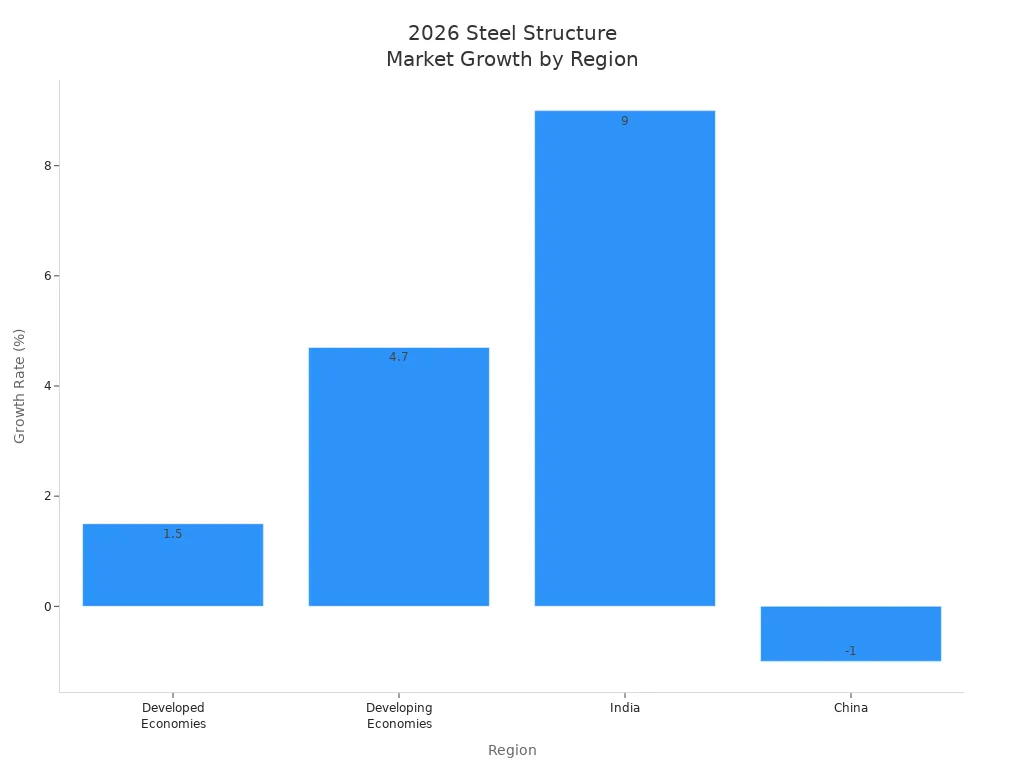
The world market for steel buildings grows by 7.7% in 2026. Asia Pacific grows over 4.5% because of more tall buildings. Developing countries, especially India, grow fast. Construction uses most steel, and green rules change what steel is needed. Builders need $3.7 trillion more for new projects, so steady money is important for future growth.
Steel structure buildings have lots of good points in 2026. You can build them quickly and they have strong frames. The layouts are flexible, so you can change them easily. These buildings stand up to bad weather and do not need much fixing. You can pick designs that you like. Using recycled steel helps the planet.
- Projects finish fast
- Buildings last long and save energy
- Open rooms work for many things
- All materials can be recycled
If you pick steel structures, you make smart choices and get ready for the future.
FAQ
What makes steel structure buildings safer than other types?
Steel does not burn. You get strong frames that resist earthquakes and storms. Bugs and mold cannot damage steel. You stay safer inside a steel building.
Can you change the layout of a steel structure building after it is built?
Yes, you can. Steel frames let you move walls or add rooms. You can expand your space when you need more room. This helps you save money and time.
How long does it take to build a steel structure building?
You finish most steel buildings faster than concrete or wood ones. Factories make the parts before they arrive. You spend less time on site. Many projects finish in weeks, not months.
Are steel structure buildings good for the environment?
Steel uses recycled materials. You help the planet by choosing steel. When you finish using the building, you recycle almost all the steel. This reduces waste and saves resources.
What types of businesses use steel structure buildings?
You see steel buildings in stores, offices, factories, and schools. Farmers use them for barns. Airports use them for hangars. You find steel structures in many industries.