When you walk past nearly any commercial building, bridge, or industrial facility, the steel frames provide the structural framework for these types of buildings. The decisions made prior to constructing any steel building can drastically affect whether that building will be structurally sound for decades or will begin to experience significant structural issues in just a few short years. Everything from selecting the proper grade of steel to designing corrosion-resistant protection will impact all phases of the building process require. The information in this guide will provide an overview of the methods used by seasoned engineers, fabricators and erectors to ensure the success of steel construction projects – from design precision and fabrication quality through site safety and long-term maintenance. No matter what type of building you are building or what size of you are specifying your first steel framed building or you are a contractor trying to improve your processes, there are many principles shared across all steel construction projects.
Foundations of Structural Steel Selection
Choosing the right steel for a project is not a one-size-fits-all decision. The grade, sourcing strategy, and environmental profile of the material all influence how the finished structure performs, what it costs, and how it ages. Getting this foundation wrong creates cascading problems that show up during fabrication, erection, and service life.
Understanding Material Grades and Properties
Most commercial construction in North America relies on ASTM A992 for wide-flange shapes, which offers a minimum yield strength of 50 ksi and good weldability. But that’s just one option. Hollow structural sections often use ASTM A500 Grade B or C, while plates might call for A572 Grade 50 or A588 for weathering applications.
The choice depends on loading conditions, connection types, and exposure. A parking garage with exposed members in a coastal climate has very different needs than an interior mezzanine in a warehouse. Specifying a higher-strength grade can reduce member sizes and weight, but it may complicate welding procedures or increase material lead times. Talk to your fabricator early: they’ll tell you which grades they stock, which require special procurement, and where substitutions make sense without affecting design intent.
The Role of Sustainability in Modern Steel Sourcing
Steel is one of the most recycled materials on earth. Electric arc furnace mills produce structural shapes using roughly 90% recycled content, and the energy required per ton has dropped significantly over the past two decades. For projects targeting LEED or similar certifications, documenting recycled content through mill certifications is straightforward.
Beyond recycled content, sourcing locally reduces transportation emissions and lead times. Some project teams now request Environmental Product Declarations from mills, which quantify the carbon footprint of specific products. If your client cares about embodied carbon, these documents give you real numbers to work with rather than vague claims. The trend toward low-carbon steel is accelerating, and specifiers who understand the supply chain can make meaningful choices without blowing the budget.
Precision in Design and Engineering
A steel structure is only as good as its design documentation. Errors caught on paper cost almost nothing to fix. Errors caught during erection can cost tens of thousands of dollars and weeks of delay.
Leveraging BIM for Error-Free Detailing
Building Information Modeling has transformed how steel projects move from concept to fabrication. A well-built 3D model catches clashes between structural members, mechanical systems, and architectural elements before anyone cuts a single piece of steel. Programs like Tekla Structures and SDS/2 generate shop drawings directly from the model, reducing manual drafting errors.
The real value shows up in coordination. When the mechanical engineer’s ductwork conflicts with a beam flange, you want to know that in a virtual model, not on a job site with a crane idling at $400 per hour. Running clash detection at regular intervals during design development is standard practice on well-managed projects. Insist on it, and make sure all disciplines are feeding current models into the coordination process.
Load Calculations and Stress Distribution
Getting load paths right is fundamental. Dead loads, live loads, wind, seismic forces, and thermal effects all need to be accounted for, and the interaction between them matters as much as the individual values. A 40-story tower in a seismic zone requires moment frames or braced frames designed to absorb lateral energy without collapse. A single-story retail building might only need simple shear connections.
Software like ETABS, SAP2000, and RISA handles the heavy math, but the engineer still needs to understand what the numbers mean. Overly conservative designs waste material and money. Underdesigned connections fail. The sweet spot requires experience, peer review, and honest conversations between the engineer of record and the fabricator’s detailing team about constructability.
Fabrication + Quality control standards
The fabrication shop is where what you intend and create will become an object in reality. If your quality control checks pass, then your parts will all fit together on site; otherwise you may experience significant additional costs to rework out of tolerance parts.
Shop drawing approval processes
The shop drawings are the engineering documents used to create the fabrication instructions that will be utilised to manufacture the steel components being assembled in the field. The shop drawings will display all of the cuts or holes or copes or welds required to fabricate the steel components. The standard approval cycle for Shop Drawings is as follows: The Detailer develops and submits the Shop Drawings to the Engineer of Record (EOR) for review and comment, then the Detailer returns the Shop Drawings to the EOR for revision and final approval prior to fabrication.
Some of the biggest reasons for getting behind schedule on your project are due to delays within this cycle itself. So, be sure to set up clear turn-around time expectations during start up of your project like, five or seven working days for submissions, etc. As an example, design compliance, not redlining of drafting preferences, should be used by engineers to review submittals. Fabricators should submit their submittals in sequences that logically correspond to how it will be erected according to the Erection Plan instead of submitting submittals in a random fashion.
Welding and Bolting Quality Assurance
For structural steel projects, all welded joints must adhere to AWS D1.1 requirements. When dealing with critical welds, you must perform either ultrasonic or radiographic examinations. The fabricator’s welding procedures will need either to have been approved through pre-qualification or have already been qualified through testing. The welders performing the work will need to have current certifications for the specific welding processes they will use and for the same positions as what they will weld on the project.
Bolted connections are subject to their own distinct quality standards. High strength bolts in slip-critical applications need to be properly pretensioned and the correct pretensioning must be verified with one of several approved methods, including the turn-of-nut method, calibrated wrench method, or direct tension indicator method. All of these procedures will be documented in the quality program of any AISC-certified fabricator, which is why most project specifications require this certification. if the fabricator you use is NOT AISC certified, ask the reason, and also consider whether the benefit you get from using that supplier will offset the higher risk you face by using it.
On-Site Construction
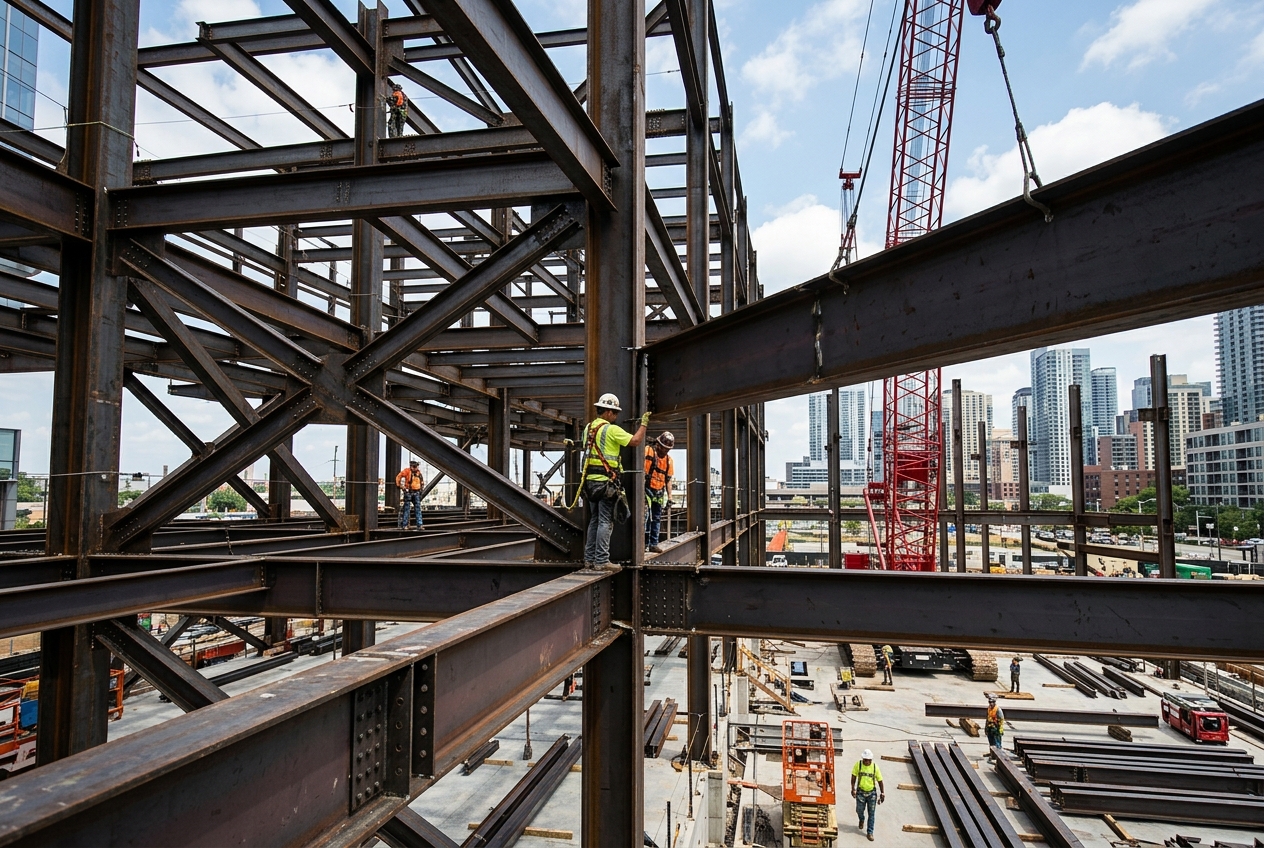
Erection is the time when all the hard work and planning comes together (or not). The steel erection is assembled rapidly; therefore, a professional can get dozens completed within a single work day. Rapid coupled with not efficient would result in accidents and misaligned steel.
Security Practices of Heavy Lifts and Rigging.
One of the riskiest forms of construction work is steel erection. OSHA’s Subpart R (29 CFR 1926.750-761) outlines basic guidelines, but competent contractors will surpass these standards. The rigging configuration of each lift needs to be predetermined before the crane operator will be ready to lift the load. The crane operator also needs to know the weight of each lift, the radius, and the boom angle prior to being attached to the steel with the hook.
Connectors who operate at elevated heights must always remain tethered unless working inside a controlled decking area. Fall protection is non-negotiable. On-site Erection plans must identify anchor points, temporary perimeter protections, and emergency rescue procedures. A single serious accident can shut down a job for weeks and cost lives. No schedule pressure is worth that risk.
Sequencing for Structural Stability
The sequence of the component installation is very important. Partially constructed frames are not stable and wind loads affect open structures quite differently from the way they affect closed, completed buildings. The erection sequence should be planned by a qualified engineer and account for temporary bracing, connection completion, and decking installation.
Temporary bracing must be maintained until sufficient permanent connections have been made to ensure stability. It is very common, and very dangerous, to remove the temporary braces too early. The erection plan should specifically state when the temporary braces can be removed. Once that point has been reached, both the ironworker foreman and the project engineer should sign off on the removal of the temporary braces.
Corrosion Protection and Fireproofing
The two primary weaknesses of steel are rust (corrosion) and heat (fire). To properly address both issues, they must be addressed in the design phase, not as an afterthought in the construction phase.
Protective Coatings and Galvanizing Techniques
A shop applied primer is often enough for most interior projects. But if the steel is exposed to the environment, such as in humid conditions, industrial areas or above water (marine) then you use more than one coat of paint. Typical multi-coat systems include a zinc-rich primer, epoxy intermediate coat, and a polyurethane topcoat. In addition to the system’s compatibility, the total thickness of the coatings are key criteria; manufacturers’ application criteria should be adhered to.
If you’re looking for a way to make sure your steel structure doesn’t rust away outside for a really long time, hot-dip galvanizing will be the best option. In this process the steel is basically dipped into a bath of hot, molten zinc at about 840F. The two metal types actually bond together to form a metallurgical bond! Yes, the upfront cost of galvanization is more than typical paint applications, but so is the life expectancy of the galvanized steel, with most products lasting 50+ years before they need any maintenance. So, if it is going to be difficult or expensive to access the steel to do repainting in the future, galvanization will most likely be the most cost-effective solution to protect the steel over the life of the project.
Passive Fire Protection Systems
Unprotected steel rapidly degrades in strength as the temperature rises. At approximately 1000°F, most structural steels will only retain approximately 60% of their room temperature yield strength. Building Code requires that Structural members must be Fire-Resistance Rated and the time period for such ratings is generally between 1-3 hours, depending on occupancy and height of your building.
Long-Term Maintenance and Structural Integrity
Spray-applied fire-resistive materials (SFRM) serve as the primary traditional method and are typically coated directly on steel structures upon their erection. Intumescent coatings are an aesthetically pleasing alternative with a thinner profile and exhibit a paint appearance at room temperature. However, when subjected to fire, these coatings expand to form a protective insulating char. Gypsum and Calcium Board Systems are an alternative system when spray applications are not possible due to the area of use. The selection of the appropriate product is based on the aesthetics, cost, and the level of fire rating required.
Once a steel building reaches the point of receiving a certificate of occupancy, it continues to require ongoing attention and care. Periodic inspection along with routine maintenance provides security for your investment and ensures the safety of your occupants. Properly maintained structural steel can last well over 100 years, while lack of maintenance will accelerate the ongoing degradation of the steel.
The inspection programs must look at the conditions of the connection, the coating, and whether or not the connections are corroded or have fatigue cracks. Those connections that are subjected to the highest loads (e.g. beam and column connections, bracing gusset plates, etc.) as well as connections that are exposed to moisture require the greatest amount of attention during this process. After an earthquake, the connections in a moment frame are extremely important in the buildings located in seismic regions.
A normal cycle is followed for coating maintenance. Recoat the areas immediately which are found damaged so that the rust can not grow. Prepare a plan to recoat the building before the present coating is fully out of service; recoating over sound paint is much cheaper as compared to removing it fully and recoating it again. A period of time is necessary where you will have to provide records of the inspections, repairing and coating. These records of coatings will provide you significant support either you will sell building, claim insurance, or do any modifications in structure of building.
Good steel buildings have one thing in common.they all come from teams that respect building materials, construction times, and decades worth of maintenance. Every single step taken, if any one is bypassed or should one be done improperly, causes complications that exacerbate with time. Should you be planning to begin a building project with steel framing you will want to take your time and do things correctly from the onset. Ensure you hire certified fabricators; demand that certified crews erect your building; develop your corrosion prevention plans early, and dedicate yourself to maintaining your steel building as it was designed and built to be used. All of your initial investment in time is worthwhile.