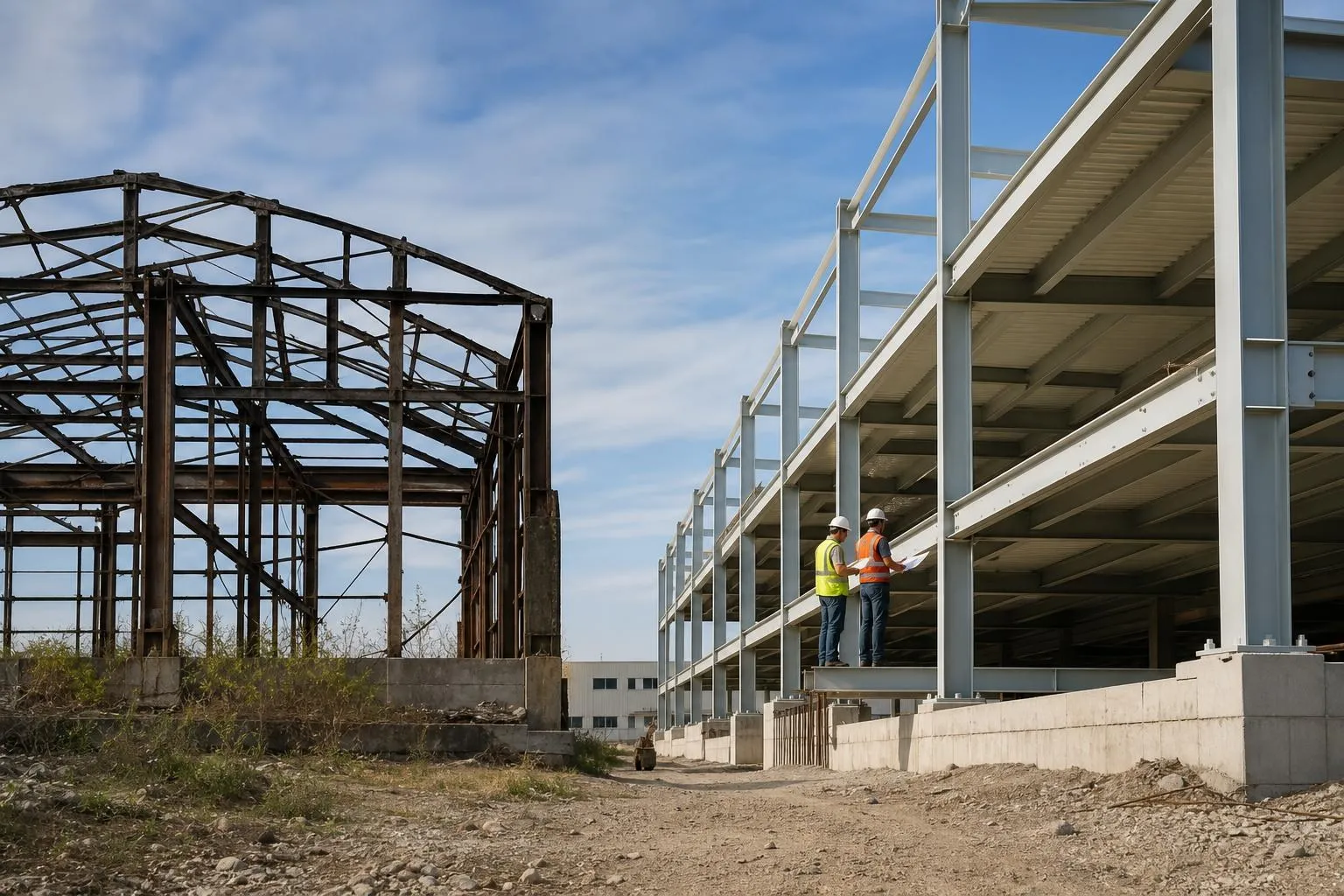
Steel buildings can be seen all over the place, yet most individuals barely take notice of them. so many of the buildings that you encounter each day have a large chance that they began life as prefab steel parts bolted together on site. warehouses, hospitals, schools, data centers, apartment buildings, etc. However, this situation has not always existed. The boundaries of the evolution of prefabricated steel construction, from basic iron frames to AI-created modular construction will be nearly two hundred years and will broadly parallel the most significant technological advancements made by humans.
There’s more than just nostalgia making it a good story. The story of how we got here will help you to see where this industry is going and the speed at which all of these changes are happening is unprecedented in the construction industry. The story of prefabricated steel is important because it shows how people make things, change the way they build, and think about what they can do. There are now new materials, new ways to make things electronically, and many people are concerned about the environment. All of these things will come together to change entire cities in the next ten years. If you care about how things are built, then the direction of construction will be very important to you.
Origins and the Industrial Revolution Breakthrough
Early Iron Structures and the Crystal Palace Legacy
The roots of prefabricated metal construction trace back to the early 1800s, when cast iron columns began replacing timber in factories and bridges across Britain. These early iron structures were crude by modern standards, but they introduced a radical concept: standardized components manufactured off-site and assembled at the building location.
The real turning point came in 1851 with Joseph Paxton’s Crystal Palace in London. Built for the Great Exhibition, this enormous glass-and-iron structure covered 990,000 square feet and was erected in just nine months. The entire building relied on prefabricated iron columns, girders, and glass panels produced in factories and shipped to Hyde Park. It proved that large, complex structures could be assembled from standardized parts at remarkable speed.
After the Crystal Palace, iron and early steel prefabrication spread to colonial buildings, railway stations, and even portable houses shipped to California during the Gold Rush. The concept was proven. What it needed was scale.
Standardization During the World Wars
Both World Wars forced governments to build fast and cheap, which turned out to be exactly the conditions prefabricated steel needed to mature. During World War I, military hangars and temporary barracks were mass-produced using steel frames. The Nissen hut, a semicircular structure of corrugated steel sheets over steel ribs, became iconic precisely because it could be assembled by unskilled workers in hours.
World War II pushed standardization even further. The United States alone produced thousands of Quonset huts, a refined version of the Nissen design. Steel shipbuilding techniques crossed over into construction, and welding replaced riveting as the primary joining method. By 1945, the infrastructure for mass-producing steel building components existed on an industrial scale. The postwar building boom in Europe and North America rode directly on these wartime innovations, setting the stage for the pre-engineered building industry that would emerge in the following decades.
The Rise of Modern Pre-Engineered Buildings
Shift from Hot-Rolled to Cold-Formed Steel
Through the 1950s and 1960s, pre-engineered metal buildings became a distinct product category. Companies like Butler Manufacturing and Nucor began offering complete building systems: steel frames, wall panels, roofing, and accessories designed as integrated packages. The key innovation during this period was the growing use of cold-formed steel alongside traditional hot-rolled sections.
Cold-formed steel, shaped at room temperature from thin steel sheets, offered a lighter and more economical alternative for secondary framing, purlins, and girts. It didn’t replace hot-rolled steel for primary structural members, but it dramatically reduced overall building weight and cost. By the 1970s, a typical pre-engineered building used 30-40% less steel by weight than a conventionally designed structure of the same size.
This efficiency gain made steel prefabrication competitive for a much wider range of projects: retail stores, churches, recreational facilities, and small offices, not just warehouses and factories.
Advancements in High-Strength Steel Alloys
Material science kept pushing the boundaries. High-strength low-alloy steels, often called HSLA steels, allowed engineers to design thinner, lighter members that carried the same loads as heavier conventional sections. Grades like ASTM A992, which became the standard for wide-flange shapes in the early 2000s, offered yield strengths of 50 ksi compared to the 36 ksi that was common in earlier decades.
The practical result was significant. A column designed with A992 steel could be substantially lighter than one designed with A36 steel for the same load condition. Multiply that savings across an entire building frame, and you’re looking at meaningful reductions in material cost, transportation weight, and foundation requirements. By 2026, some specialty alloys used in prefabricated construction exceed 70 ksi yield strength, enabling multi-story modular steel buildings that would have been impractical just twenty years ago.
Digital Transformation in Steel Design and Fabrication
BIM and Seamless CAD-to-CAM Integration
The single biggest change in how prefabricated steel buildings get designed and manufactured happened not in the steel mill but on the computer screen. Building Information Modeling, or BIM, transformed steel construction from a 2D drafting exercise into a fully coordinated 3D digital workflow.
In a modern steel fabrication shop, the BIM model isn’t just a visualization tool. It’s the production document. Connection details, bolt patterns, weld specifications, and member dimensions flow directly from the design model into CNC machines. This direct CAD-to-CAM pipeline eliminates the traditional handoff between detailers and fabricators where errors historically crept in. A 2024 study by the American Institute of Steel Construction found that shops using integrated BIM-to-fabrication workflows reduced rework rates by roughly 60% compared to shops relying on traditional 2D shop drawings.
The speed gains are equally striking. Projects that once required weeks of manual detailing now move from design approval to fabrication start in days.
Precision Robotics in Off-Site Manufacturing
Robotic welding, automated beam drilling, and CNC plasma cutting have become standard equipment in mid-to-large steel fabrication facilities. These machines don’t just work faster than human operators: they work with tolerances measured in fractions of a millimeter, which matters enormously when you’re assembling a building from hundreds of components that need to fit together precisely on-site.
Automated beam lines can process a steel member from raw stock to finished piece, drilling all holes, cutting to length, and marking layout lines, in minutes rather than hours. Some facilities in 2026 run lights-out shifts where robotic systems fabricate steel components overnight with minimal human oversight. The result is a factory-like consistency that traditional field construction simply cannot match. Off-site manufacturing also moves work indoors, eliminating weather delays and improving worker safety, two persistent problems in conventional construction.
Sustainability and Circular Economy Benefits
Recyclability and Reduced Material Waste
Steel is the most recycled material on Earth, and that’s not marketing spin. Over 90% of structural steel in demolished buildings gets recycled into new steel products. The electric arc furnace process, which now accounts for roughly 70% of U.S. steel production, runs primarily on scrap steel. This creates a genuine closed loop that few other construction materials can claim.
Prefabrication amplifies these environmental benefits. Factory cutting and fabrication generate far less waste than field construction because components are produced to exact specifications with computerized nesting algorithms that minimize scrap. Typical material waste rates in a modern prefab steel facility run between 2-5%, compared to 10-15% waste rates common on conventional construction sites. The scrap that is generated stays in the factory and goes directly back to recyclers, rather than ending up in a construction dumpsite.
Energy Efficiency in Prefabricated Envelopes
The old criticism that steel buildings are energy hogs has largely been addressed through insulated metal panel systems and advanced thermal envelope designs. Modern prefabricated wall and roof panels integrate continuous insulation, vapor barriers, and air sealing into factory-assembled units that perform significantly better than field-built assemblies.
R-values for insulated metal panel systems now commonly reach R-30 or higher for walls and R-40+ for roofs, meeting or exceeding energy code requirements across most climate zones. The factory-controlled manufacturing process ensures consistent insulation thickness and eliminates the thermal bridging gaps that plague field-installed batt insulation. Several net-zero energy steel buildings completed in 2025 and 2026 demonstrate that prefabricated steel envelopes, combined with rooftop solar and efficient HVAC systems, can achieve energy performance on par with the best wood-frame or concrete construction.
Future Horizons: AI and Adaptive Steel Modular Systems
Generative Design for Structural Optimization
Generative design algorithms are changing how engineers approach steel structures. Instead of designing a beam or connection and then checking whether it works, engineers now define the loads, constraints, and performance goals, and the software generates dozens or hundreds of possible solutions ranked by weight, cost, or carbon footprint.
Autodesk and Bentley both offer generative design tools specifically tuned for structural steel in 2026. These tools have produced frame designs that use 15-25% less steel than conventionally engineered alternatives while meeting identical code requirements. The shapes they generate sometimes look unusual, with variable-depth members and organic-looking connection geometries, but they’re structurally sound and increasingly manufacturable thanks to advances in CNC fabrication. This is where the evolution of prefabricated steel construction points most clearly toward its future: structures designed by algorithms and built by robots, with human engineers guiding the process rather than drawing every line.
3D Metal Printing and On-Site Automated Assembly
Large-scale metal 3D printing has moved from laboratory curiosity to commercial reality. MX3D’s 3D-printed steel bridge in Amsterdam, completed in 2021, was an early proof of concept. By 2026, several companies offer 3D-printed steel nodes and connections for commercial building projects, particularly for complex geometries that would be expensive or impossible to fabricate conventionally.
On-site automated assembly is progressing in parallel. Robotic bolt-tightening systems, drone-based inspection, and GPS-guided crane positioning are reducing the labor intensity of steel erection. A pilot project in Singapore completed in late 2025 used semi-autonomous robots to assemble a six-story modular steel building, cutting on-site labor hours by nearly 40% compared to conventional erection methods. These technologies aren’t replacing ironworkers overnight, but they’re changing the skill mix and productivity equation on steel construction sites in measurable ways.
Where Prefabricated Steel Goes From Here
The trajectory from the Crystal Palace to AI-designed, robotically fabricated steel modules covers 175 years of continuous innovation. Each era built on the last: wartime standardization enabled pre-engineered buildings, which drove demand for better alloys, which benefited from digital design tools, which now feed into automated manufacturing systems.
The biggest shifts ahead involve carbon reduction and speed. The steel industry is investing heavily in hydrogen-based steelmaking to eliminate coal from the production process, with several pilot plants operating in Sweden and Germany. If green steel scales as projected, prefabricated steel construction could become one of the lowest-carbon structural systems available by the early 2030s.
For anyone involved in building design, development, or construction management, paying attention to how prefabricated steel is evolving isn’t optional anymore. The companies and designers who understand these trends will build faster, waste less, and deliver better-performing buildings. The ones who don’t will find themselves outpaced by competitors who figured it out sooner.