Every major city skyline tells the same story: steel holds the modern world up. From the 100-story towers reshaping Gulf State capitals to the prefabricated warehouses going up in 30 days across the American Midwest, steel structure buildings dominate commercial and industrial construction for reasons that go far beyond tradition. If you’ve ever wondered what exactly qualifies as a steel structure building, what parts make it work, and why architects and developers keep choosing it over concrete and timber, this is the breakdown you need. Understanding the definition, components, and core advantages of steel buildings will help you make smarter decisions whether you’re planning a small workshop or a multi-story office complex.
Defining Steel Structure Buildings and Modern Engineering
A steel structure building is any building whose primary load-bearing framework is made from structural steel. That framework carries the weight of the roof, walls, floors, occupants, equipment, and environmental forces like wind and seismic activity. The steel skeleton does the heavy lifting, while cladding materials like metal panels, glass, or masonry serve as the building’s skin. This stands in contrast to load-bearing masonry construction, where the walls themselves support the structure, or reinforced concrete frames, where poured concrete and rebar handle the loads.
What makes steel framing distinct is how the members are manufactured. Columns, beams, and trusses arrive on-site pre-fabricated to precise specifications, often with bolt holes already drilled. The building goes together more like an assembly than a traditional pour-and-cure process.
The Evolution of Structural Steel in Construction
Steel framing traces back to the 1880s, when the Home Insurance Building in Chicago became the first structure to use a metal skeleton. By the early 1900s, structural steel had made skyscrapers possible. The real acceleration came after World War II, when surplus steel production capacity and improved welding techniques made steel buildings economically viable for warehouses, factories, and commercial buildings, not just prestige towers.
In 2026, advances in high-strength low-alloy (HSLA) steels and computer-aided design have pushed the material even further. Building information modeling (BIM) software now coordinates every connection detail before a single beam is cut, reducing waste and on-site errors dramatically.
Common Types of Steel Frame Systems
Steel buildings generally fall into a few categories. Rigid frame (or portal frame) structures use moment-resistant connections between columns and rafters, making them ideal for warehouses and aircraft hangars. Braced frame systems add diagonal bracing members to resist lateral forces, common in multi-story office and residential buildings. Truss systems use triangulated members to span long distances and are frequently seen in bridges, arenas, and convention centers. Pre-engineered metal buildings (PEMBs) are a subcategory where every component is factory-designed and fabricated as a kit, then bolted together on-site. PEMBs account for a significant share of low-rise commercial construction across North America and Asia.
Primary Structural Components and Materials
The skeleton of a steel building consists of primary and secondary members connected through bolts, welds, or a combination of both. Each component has a specific job, and understanding them helps you communicate with engineers and contractors without getting lost in jargon.
Primary Members: Columns, Beams, and Trusses
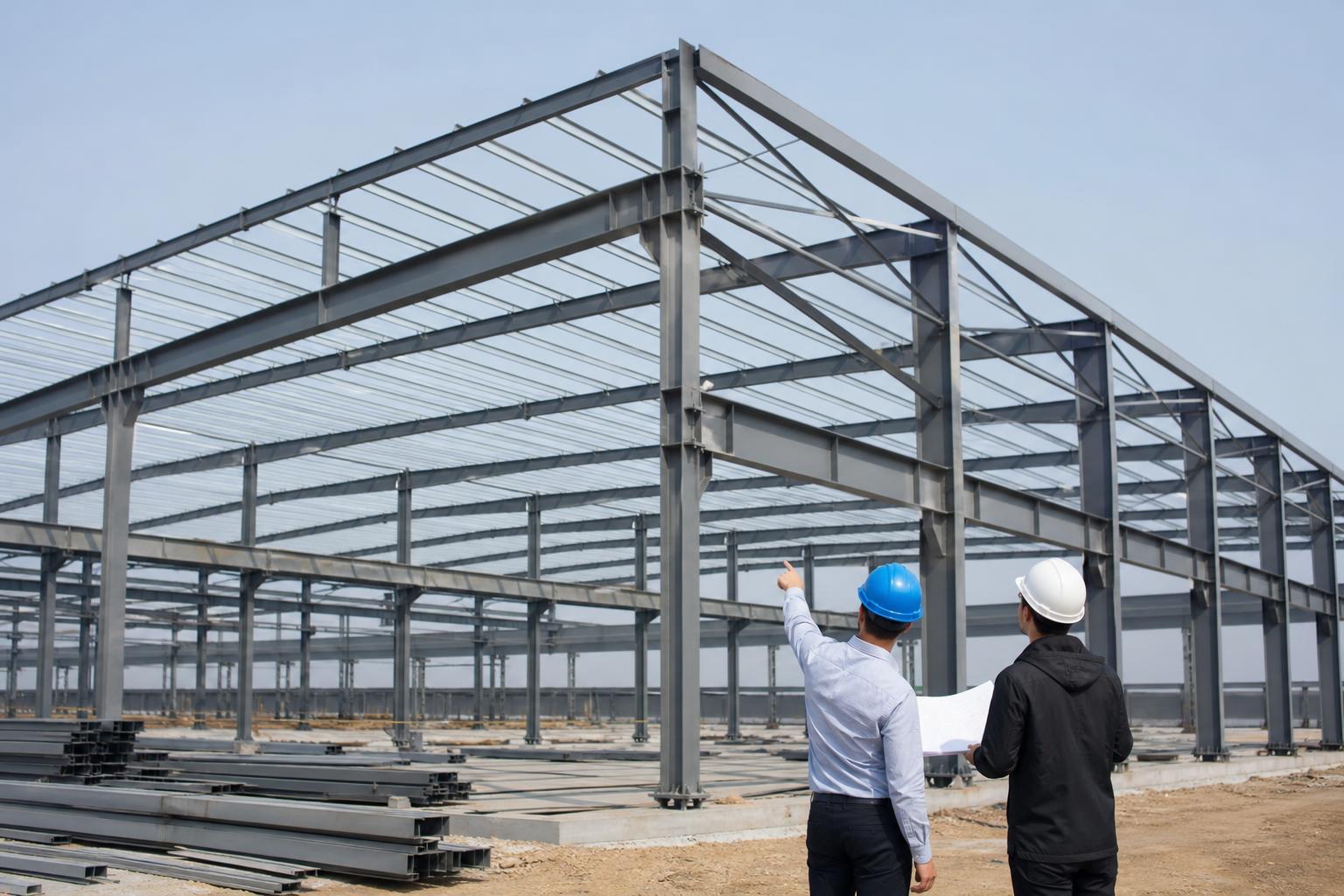
Columns are the vertical members that transfer loads from the roof and floors down to the foundation. They’re typically wide-flange (I-shaped) sections or hollow structural sections (HSS), depending on the load requirements and architectural intent. Beams run horizontally, spanning between columns to support floors and roofs. In single-story buildings, the primary beam is often the rafter, which follows the roof slope.
Trusses replace solid beams when you need to span large distances without intermediate supports. A typical Warren or Pratt truss can clear 40 meters or more, which is why you see them in sports arenas and distribution centers. The triangulated geometry distributes forces efficiently through tension and compression members, using less steel than a solid beam of equivalent capacity.
Secondary Framing: Purlins, Girts, and Eave Struts
Secondary members don’t carry the main structural loads, but they’re essential. Purlins run horizontally across the roof between rafters, supporting the roof sheeting and transferring loads back to the primary frame. Girts do the same job on the walls. Eave struts sit at the junction of the wall and roof, tying the two planes together and providing a critical connection point.
These members are usually cold-formed Z or C sections, lighter and cheaper than hot-rolled shapes. They’re spaced at intervals of 1.2 to 2.4 meters, depending on the cladding system and local wind or snow loads.
Connection Methods: Bolting vs. Welding
Connections are where steel buildings succeed or fail. High-strength bolts (typically ASTM A325 or A490 grades) are the standard for field connections because they’re fast, inspectable, and don’t require specialized labor on-site. Shop welding, done in the fabrication facility under controlled conditions, produces stronger and cleaner joints.
Most modern steel buildings use a hybrid approach: shop-welded assemblies with field-bolted connections. This gives you the strength of welding where it matters most and the speed of bolting during erection. A poorly designed connection can be the weakest link in an otherwise strong frame, so this is where experienced structural engineers earn their fee.
Core Advantages of Steel over Traditional Materials
Steel’s dominance in commercial and industrial construction isn’t accidental. The material offers a combination of properties that concrete, timber, and masonry simply can’t match in many applications.
Unmatched Strength-to-Weight Ratio
Structural steel delivers roughly 10 times the tensile strength of concrete per unit of weight. A steel column supporting 500 kN might weigh 50 kg per meter, while a concrete column handling the same load could weigh 400 kg per meter or more. This matters enormously for foundations: lighter superstructures need smaller, cheaper footings. In areas with poor soil conditions, that weight savings can determine whether a project is financially feasible at all.
Design Flexibility and Large Clear Spans
Steel lets architects create open floor plans and column-free interiors that other materials struggle to achieve. A pre-engineered rigid frame can span 90 meters without a single interior column. That’s why every major fulfillment center, airplane hangar, and indoor arena you’ve seen is built with steel.
The material is also easy to modify after construction. Adding a mezzanine, cutting a new opening, or extending a building is straightforward with steel. Try adding a 10-meter opening in a load-bearing concrete wall and you’ll appreciate the difference quickly.
Durability and Resistance to Environmental Hazards
Steel doesn’t rot, warp, split, or get eaten by termites. With proper coatings (galvanizing, epoxy primers, or intumescent fire protection), a steel frame can last 50 to 100 years with minimal structural maintenance. In seismic zones, steel’s ductility is a major safety advantage: it bends before it breaks, absorbing earthquake energy rather than crumbling like unreinforced masonry.
Corrosion is the primary enemy, but modern protective systems have largely solved this. Hot-dip galvanizing alone provides 50+ years of protection in most environments, and weathering steels like Cor-Ten develop a protective rust layer that eliminates the need for painting entirely.
Economic and Operational Benefits
Beyond structural performance, steel buildings offer financial advantages that show up both during construction and across the building’s lifespan.
Speed of Fabrication and Rapid On-Site Assembly
A typical pre-engineered steel building can go from order to occupancy in 8 to 14 weeks. Compare that to 6 to 12 months for a comparable reinforced concrete structure. The speed comes from parallel workflows: foundations are poured while steel is being fabricated hundreds of miles away. Once the steel arrives, erection crews can raise a 1,000-square-meter frame in a matter of days.
Faster construction means earlier revenue generation for the owner, lower financing costs, and reduced exposure to weather delays. For a retail or logistics client, shaving three months off a construction schedule can translate to hundreds of thousands of dollars in earlier income.
Long-Term Maintenance and Life Cycle Costs
Steel buildings typically require repainting or recoating every 15 to 25 years, depending on the environment. Structural inspections are straightforward because connections are visible and accessible. Contrast this with concrete structures, where hidden rebar corrosion can go undetected until spalling appears on the surface.
Over a 50-year life cycle, studies consistently show steel buildings cost 10 to 20 percent less to maintain than equivalent concrete structures, particularly in industrial settings where chemical exposure or heavy vibration is a factor.
Sustainability and the Future of Green Building
Steel’s environmental credentials have improved significantly, and the material now plays a central role in green building certification programs worldwide.
Recyclability and Reduced Construction Waste
Steel is the most recycled material on Earth. In 2026, over 90 percent of structural steel in North America contains recycled content, and every piece of steel removed from a demolished building goes back into the supply chain. Electric arc furnace (EAF) steelmaking, which uses scrap as its primary input, now accounts for roughly 70 percent of U.S. steel production and produces a fraction of the carbon emissions of traditional blast furnace methods.
Pre-engineered steel buildings generate very little on-site waste because components arrive cut and drilled to specification. Typical construction waste rates for steel buildings run 2 to 5 percent, compared to 10 to 15 percent for cast-in-place concrete projects.
Energy Efficiency and Thermal Insulation Integration
Steel framing itself is a poor insulator, but modern building systems address this effectively. Insulated metal panels (IMPs) with polyurethane or mineral wool cores provide R-values of 25 or higher in a single panel, and thermally broken connections prevent cold bridging through the frame. Cool-roof coatings on metal roofing reflect solar radiation, reducing cooling loads by up to 20 percent in warm climates.
Many LEED and BREEAM-certified buildings in 2026 use steel framing specifically because the combination of recycled content, low waste, and high-performance insulation systems makes it easier to hit sustainability targets.
Selecting the Right Steel Solution for Your Project
Choosing a steel structure building comes down to matching the system to your specific needs. A single-story warehouse with 60-meter clear spans calls for a rigid frame PEMB. A five-story office building in a seismic zone needs a braced or moment-resistant frame designed by a licensed structural engineer. A cold storage facility requires insulated panels and vapor barriers integrated into the steel envelope.
Start by defining your clear span requirements, building height, local building codes, and environmental exposure. Get quotes from at least two or three steel building suppliers and compare not just price but delivery timeline, engineering support, and warranty terms. Ask for references from completed projects similar to yours.
The advantages of steel construction – strength, speed, flexibility, and long-term economy – are real and well-documented. But those benefits only materialize when the design, fabrication, and erection are handled by competent professionals. Invest in good engineering upfront, and your steel building will perform reliably for decades with minimal headaches.